Vocalist Agreement Template - Flat Fee Buyout Contract
Vocalist Agreement Template - Flat Fee Buyout Contract
Couldn't load pickup availability
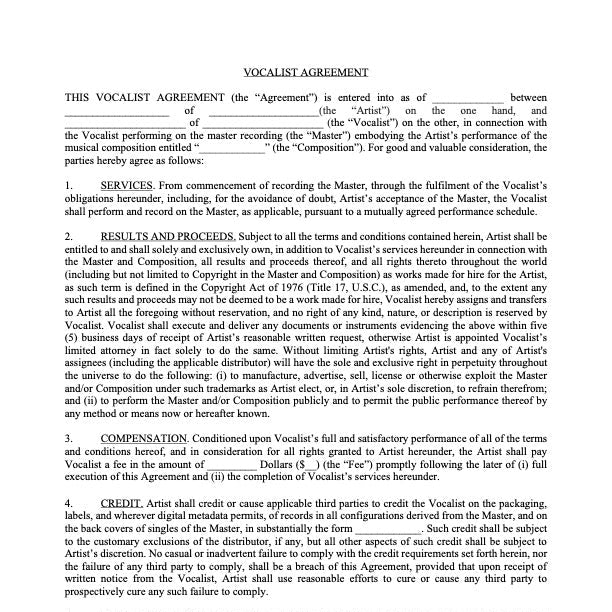
Hiring a vocalist without a written agreement is how you end up with someone claiming co-ownership of your song. A vocalist agreement is the contract that pays a singer a flat fee for a recorded performance and transfers ownership of that performance to you, with no royalty and no share of the composition. This two-page template is built for that one scenario: you pay once, you own everything they record.
Written by Adam Freedman, a music attorney with more than 10 years of experience, admitted in New York.
Which release or hire form do you need?
The short answer: it depends on what the person did on your project. Performed on the recording, appeared on camera, made the artwork, or just saw something unreleased. The row highlighted below is this page.
| Form | Who signs it | What you get |
|---|---|---|
|
Vocalist Agreement $15 (this page) |
A singer you hire for a vocal, not a featured artist | Flat fee buyout of the vocal performance |
|
Session Musician Contract $15 |
A musician you hire to play on a recording | Work-for-hire buyout of the performance, no backend |
|
Graphic Designer Work-for-Hire $12 |
Whoever makes your cover art, logo, or visual assets | Ownership of the artwork, not just permission to use it |
|
Appearance Release $5 |
Anyone identifiable on camera: featured talent, dancers, extras | The right to use their likeness in the video and every clip from it |
|
Non-Disclosure Agreement $10 |
Anyone you show unreleased music, plans, or numbers to | A written confidentiality obligation before you share |
|
Complete Music Contract Vault $75 |
Everyone above, plus producers, featured artists, and labels | All of it, and the deal templates too |
If the singer is being credited as a feature and taking a percentage, this is the wrong document. That is a Featured Artist Agreement.
What's included
Payment & compensation
- Flat fee payment terms: the agreed amount and when it is due
- Work-for-hire structure: the vocalist is compensated once, with no ongoing royalty obligation
- No backend participation: no claim to streaming revenue, sync fees, or any future income from the recording
Rights transfer
- Full master ownership: the hiring party owns 100% of the master recording including the vocal performance
- No publishing rights: the vocalist receives no share of the underlying composition. If they also wrote, that is a separate Songwriter Agreement
- Worldwide, perpetual rights: use the recording anywhere, forever, with no additional payment
Legal protections
- Warranties and representations: the vocalist confirms they have the right to perform and record
- No conflicting exclusivity: the vocalist confirms no union or exclusive agreement that would affect the recording
- Credit provisions: whether and how the vocalist is credited on the release
Common mistakes this template helps you avoid
Assuming payment equals ownership: under copyright law it does not. A work-for-hire transfer has to be in writing, and "I paid them" is not a transfer.
No warranty from the vocalist: if the singer is already under an exclusive deal, their label can appear after your record is out. The warranty is what puts that risk on the person who knows the answer.
Missing credit terms: a vocalist who expected a credit and did not get one disputes it publicly, usually at release.
Silence on publishing: a singer who improvised the hook may have written part of the song. If that is the case, the buyout does not cover it and you need the songwriter paper too.
Who this is for
- Producers and beatmakers hiring vocalists for hooks, references, or demo recordings
- Independent artists paying session singers to record on their tracks
- Record labels hiring vocalists for performances on releases
- Anyone paying a vocalist a flat fee and needing full ownership of the performance
Frequently asked questions
What is the difference between a flat fee buyout and a royalty deal?
A buyout pays once and ends the vocalist's claim. A royalty deal pays them over the life of the record, typically in the 5 to 20% range for a featured performer. This template is buyouts only. For the royalty version, use the Featured Artist Agreement with a royalty and publishing split.
Does the vocalist get any publishing?
Not under this agreement, which covers the master recording only. If the vocalist co-wrote, add the Songwriter Agreement to document the split.
Do I have to credit them?
Your call. The template has a credit provision you fill in either way, and settling it in the document is what prevents the argument later.
How is this different from the session musician contract?
Structurally it is the same buyout, applied to a vocal rather than an instrument. If you are hiring both a singer and players, you want both templates. This post on what a music lawyer actually does covers when these distinctions start to matter.
Is it legally binding?
Yes, when both parties execute it. Copyright law requires a work-for-hire agreement to be in writing, which is exactly why a verbal deal or a payment does not do the job.
What format is the file delivered in?
Microsoft Word (.docx), editable immediately in Word, Google Docs, or Pages.
What happens after purchase
Instant download: Word (.docx) file delivered immediately after checkout
Fully editable: customize the fee, credit terms, and every provision
Lifetime access: download anytime from your account
One-time payment: no subscription
Something in the deal you can't get comfortable with? Talk it through before you sign.
Need more than one template? The Complete Music Contract Vault bundles 27 music contract templates for $75.
*DISCLAIMER: These templates are for informational purposes only, and purchasing them doesn't make us your lawyer. It's impossible to make one version that fits every situation, so you should contact a lawyer to make sure it fits yours.
Share