Non-Disclosure Agreement Template - Protect Your Confidential Business Information
Non-Disclosure Agreement Template - Protect Your Confidential Business Information
Couldn't load pickup availability
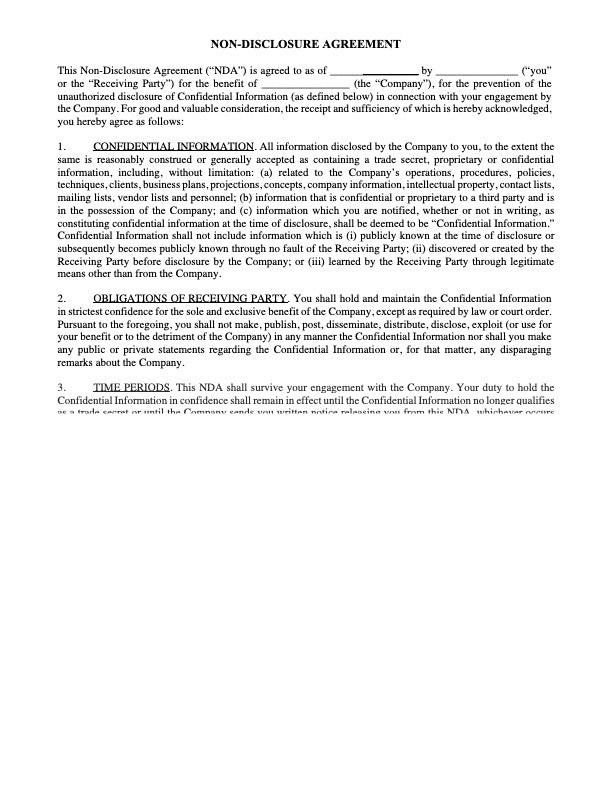
Before you share your unreleased music, your artist concept, or your business plan, get a signed NDA. A non-disclosure agreement is the contract that makes information legally confidential before it changes hands, so the person receiving it cannot pass it on or use it for anything other than the reason you shared it. This is a clean, one-page NDA built for the conversations that come up constantly in music: collaborators, producers, investors, potential hires, and early-stage business talks.
Written by Adam Freedman, a music attorney with more than 10 years of experience, admitted in New York.
Which release or hire form do you need?
The short answer: it depends on what the person did on your project. Performed on the recording, appeared on camera, made the artwork, or just saw something unreleased. The row highlighted below is this page.
| Form | Who signs it | What you get |
|---|---|---|
|
Non-Disclosure Agreement $10 (this page) |
Anyone you show unreleased music, plans, or numbers to | A written confidentiality obligation before you share |
|
Appearance Release $5 |
Anyone identifiable on camera: featured talent, dancers, extras | The right to use their likeness in the video and every clip from it |
|
Session Musician Contract $15 |
A musician you hire to play on a recording | Work-for-hire buyout of the performance, no backend |
|
Vocalist Agreement $15 |
A singer you hire for a vocal, not a featured artist | Flat fee buyout of the vocal performance |
|
Graphic Designer Work-for-Hire $12 |
Whoever makes your cover art, logo, or visual assets | Ownership of the artwork, not just permission to use it |
|
Complete Music Contract Vault $75 |
Everyone above, plus producers, featured artists, and labels | All of it, and the deal templates too |
What's included
- A broad definition of confidential information: business plans, financials, unreleased music, artist identity, creative concepts, trade secrets, client lists, and marketing strategy, with standard carve-outs so the NDA cannot be turned against information the other side already had legitimately.
- Oral disclosures: whether conversations, calls, and meetings are covered, and what confirmation makes them confidential.
- Non-disclosure and non-use: the receiving party cannot share the information, and cannot use it for anything except the purpose it was shared for, including competing with you.
- Term: a disclosure period plus a separate survival period for the confidentiality obligation, typically 2 to 5 years, or indefinite for trade secrets. Bracketed so you set it.
- Permitted disclosures: a legal-compulsion exception with prompt notice to you, and a need-to-know carve-out for the receiving party's own people, who must be bound by equivalent obligations.
- Ownership and return: nothing transfers any intellectual property, and all confidential materials come back or get destroyed on request.
- Standard protections: injunctive relief language, a one-way or mutual configuration, your choice of governing law, and a signature block that works wet or electronic.
Common mistakes this template helps you avoid
Sharing first and papering later: an NDA signed after the disclosure does very little about the disclosure that already happened. The signature goes before the send.
A generic NDA pulled off a random site: no defined term, no real definition of confidential information, no governing law. Those are the three things that decide whether an NDA does anything, and free forms routinely miss all three.
No remedy provision: an NDA that says nothing about what happens on breach gives you a lawsuit for money you cannot easily prove. The injunctive relief language is what lets you move fast.
Who this is for
- Artists and musicians sharing unreleased music, concepts, or business plans with a collaborator, manager, label, or investor who has not been formally engaged yet.
- Producers and beatmakers sending unreleased beats, stems, or project files to a potential buyer before any deal exists.
- Music entrepreneurs interviewing contractors or partners who will see proprietary information before anything is signed.
Frequently asked questions
Does an NDA protect my music or my idea?
It creates a confidentiality obligation you can enforce in court, with damages and injunctive relief available on a breach. What it does not do is stop someone using a general concept, because copyright protects expression rather than ideas. An NDA is strongest over specifics: unreleased recordings, financials, client lists. It is weakest over "I have an idea for an app."
Should this be one-way or mutual?
One-way when only you are disclosing. Mutual when both sides are sharing, which is normal for a joint venture between two artists or two companies. The template converts between the two with one noted modification.
How long should the obligation last?
Two to three years is standard for general business information. Trade secrets should run indefinitely. The template leaves it bracketed so the term matches what you are sharing.
Can I use this with someone outside the US?
Yes. It is drafted under US law and specifies US jurisdiction, which is standard for a US-based business relationship. Enforcement abroad is a separate practical question worth thinking about before you rely on it with an overseas counterparty.
Do I need an entity before I use this?
No, but the contracting party should be whatever entity owns the information. Entity formation is something we handle for music businesses if you are not set up yet.
What format is the file delivered in?
Microsoft Word (.docx), editable immediately in Word, Google Docs, or Pages.
What happens after purchase
Instant download: Word (.docx) file delivered immediately after checkout.
Fully editable: fill in the parties, the purpose of disclosure, the term, and governing law.
Attorney-drafted: one page, every legally meaningful provision, no filler.
Reusable: use the same template for every conversation that warrants one.
Want a second set of eyes before you sign? That's what a consult is for, particularly with a joint venture, an investor pitch, or a multi-party NDA.
Need more than one template? The Complete Music Contract Vault bundles 27 music contract templates for $75.
*DISCLAIMER: This template is provided as a starting point and does not constitute legal advice or create an attorney-client relationship. NDAs involving complex trade secret protections, significant financial exposure, or multi-party international arrangements should be reviewed by a qualified attorney before signing.
Share