Appearance Release Template for Music Videos
Appearance Release Template for Music Videos
Couldn't load pickup availability
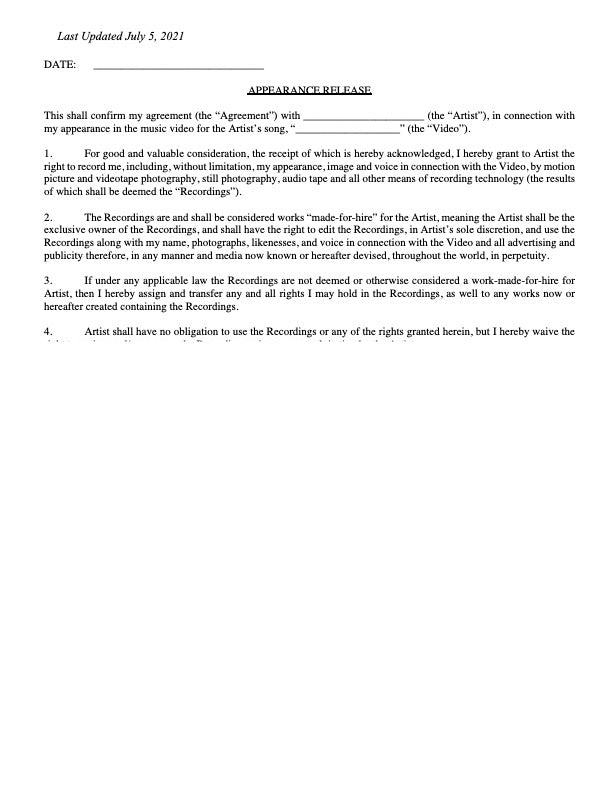
Anyone who appears in your music video needs to sign before you publish it. An appearance release is the one-page form on-screen talent signs giving you the right to use their name, image, likeness, voice, and performance in the finished video and in the clips you cut from it. Simple to fill out, simple to sign on set, and it does the one thing you need it to do.
Written by Adam Freedman, a music attorney with more than 10 years of experience, admitted in New York.
Which release or hire form do you need?
The short answer: it depends on what the person did on your project. Performed on the recording, appeared on camera, made the artwork, or just saw something unreleased. The row highlighted below is this page.
| Form | Who signs it | What you get |
|---|---|---|
|
Appearance Release $5 (this page) |
Anyone identifiable on camera: featured talent, dancers, extras | The right to use their likeness in the video and every clip from it |
|
Session Musician Contract $15 |
A musician you hire to play on a recording | Work-for-hire buyout of the performance, no backend |
|
Vocalist Agreement $15 |
A singer you hire for a vocal, not a featured artist | Flat fee buyout of the vocal performance |
|
Graphic Designer Work-for-Hire $12 |
Whoever makes your cover art, logo, or visual assets | Ownership of the artwork, not just permission to use it |
|
Non-Disclosure Agreement $10 |
Anyone you show unreleased music, plans, or numbers to | A written confidentiality obligation before you share |
|
Complete Music Contract Vault $75 |
Everyone above, plus producers, featured artists, and labels | All of it, and the deal templates too |
What's included
- Grant of rights: the person authorizes use of their name, image, likeness, voice, and performance in the video, in perpetuity, worldwide, in any format, with no approval rights over the final edit.
- Scope of use: YouTube, Vevo, streaming, and broadcast, plus promotional clips, behind-the-scenes footage, social posts, press materials, advertising and brand partnerships, and formats that do not exist yet.
- Compensation: either a flat fee acknowledged as full consideration, or confirmation that the person appeared voluntarily. Both options are in the form.
- Waiver of claims: right of publicity, privacy, and moral rights waivers covering the agreed uses.
- Minor provisions: parental or guardian consent block, required for anyone under 18 to make the release enforceable, plus an age representation for adults.
- Standard protections: indemnification, your choice of governing law, and a signature block that works on paper or a tablet on set.
Common mistakes this template helps you avoid
Publishing without a release: right of publicity laws protect a person's control over commercial uses of their name and likeness. A verbal "yeah, it's fine" on set is not a release.
A release that stops at the music video: the Instagram teaser, the TikTok, the YouTube Short, and the album rollout content all come out of that footage. If the release covers only the video, the clips are uncovered. This one covers both.
Collecting releases after the shoot: once people have scattered, signatures are close to impossible to get, and a sync licensing deal or a distributor chain-of-title request will ask for every one of them. Sign on the day.
Who this is for
- Independent artists and bands producing their own videos and needing releases from everyone on screen.
- Music video directors and production companies collecting releases on behalf of an artist or label, on a form that signs in thirty seconds.
- Labels and managers who want one consistent release across every shoot their artists do.
Frequently asked questions
Do I need a release from everyone who appears?
Anyone identifiable in the final video, or in a promotional clip from it, should sign. Unrecognizable background extras are lower risk, but collecting from everyone on set is the practice that never causes a problem later.
What if talent refuses to sign after filming?
Your options narrow to editing them out or negotiating a separate written agreement. This is the entire reason releases get signed before the camera rolls.
Does this cover a sync license or a distribution deal?
The grant is broad enough for the chain-of-title documentation a music supervisor or distributor asks for. If you are clearing a video for a placement, this piece on IP clearance in videos and audio-visual works covers what else they will want to see.
What about filming someone who did not know they were being filmed?
That is a different problem. In a controlled production everyone should know they are being filmed and sign. For street or documentary-style shooting, the rules turn on where you are shooting and what you use the footage for.
What format is the file delivered in?
Microsoft Word (.docx), editable immediately in Word, Google Docs, or Pages. Print and bring it to set.
What happens after purchase
Instant download: Word (.docx) file delivered immediately after checkout.
Fully editable: fill in the production name, shoot date, and compensation details.
Attorney-drafted: likeness rights, publicity waiver, minor provisions, and promotional use, in one page.
Reusable: use it for every person in every video you produce.
Bigger than a template? Some productions need a lawyer reading the actual paper, particularly with SAG-AFTRA talent or a brand partner attached. Book a consult.
Need more than one template? The Complete Music Contract Vault bundles 27 music contract templates for $75.
*DISCLAIMER: This template is provided as a starting point and does not constitute legal advice or create an attorney-client relationship. Productions involving SAG-AFTRA talent, significant budgets, or sync licensing for major placements should consult a qualified entertainment attorney about their specific documentation requirements.
Share