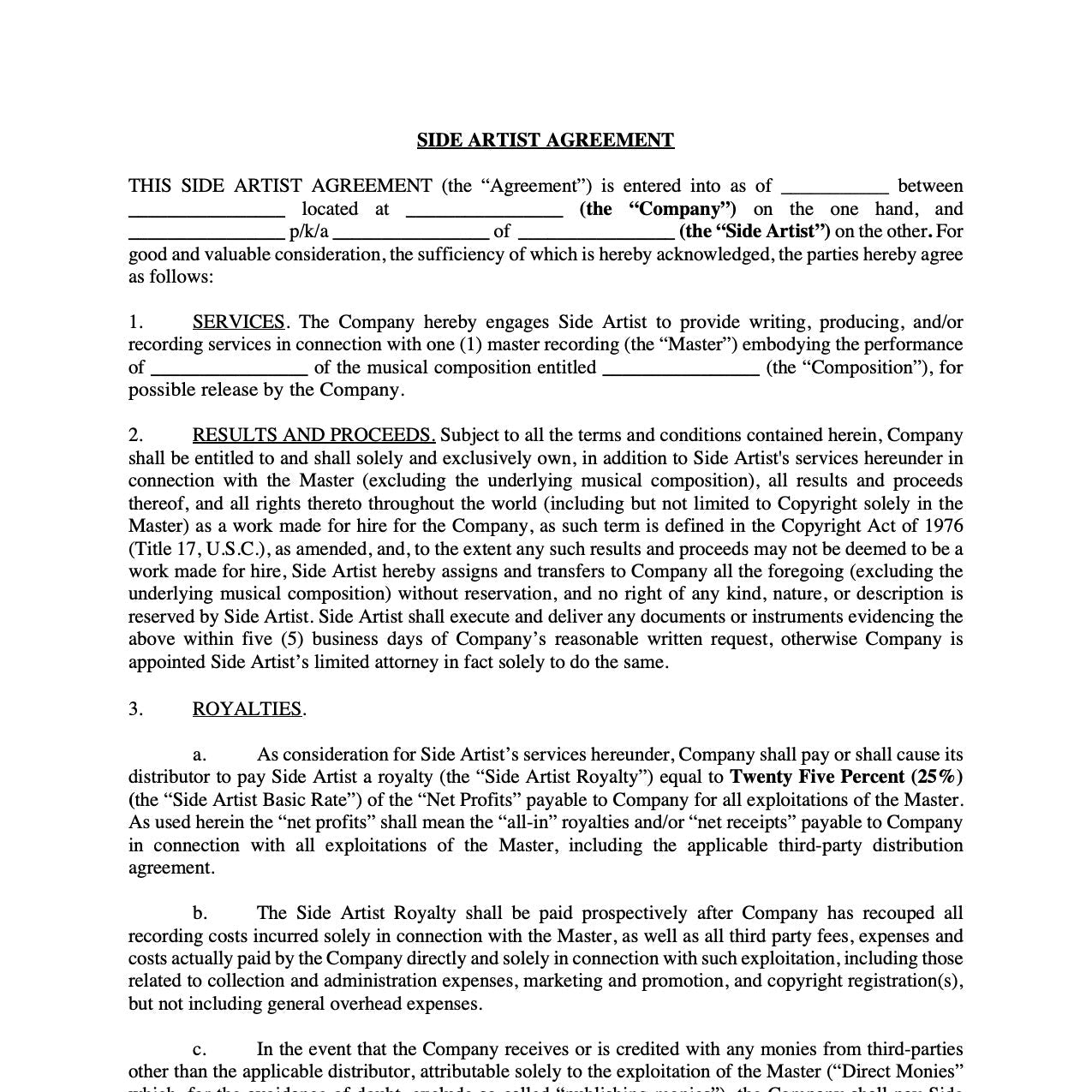
Featured Artist Agreement Template - Royalty & Publishing Split
Featured Artist Agreement Template - Royalty & Publishing Split
Couldn't load pickup availability
A featured artist who is getting royalties and a publishing split needs a real agreement, not a text message and a prayer. A featured artist agreement is the contract between the lead artist and a guest performer that sets what the guest is paid, who owns the recording, and what share of the composition they keep. This version covers the royalty plus publishing structure: a percentage of master royalties from the track and a defined share of the underlying composition.
Written by Adam Freedman, a music attorney with more than 10 years of experience, admitted in New York.
Which featured artist agreement fits your deal?
The short answer: three versions, and what separates them is who signs and how much of the compensation is spelled out. The row highlighted below is this page.
| Template | Who signs | What the featured artist gets | Use it when |
|---|---|---|---|
|
Direct Artist Deal $20 |
The artist, personally | Royalty, an optional upfront fee, and a publishing share if they co-wrote | The artist has no company and is not signed elsewhere |
|
Furnishing Company $20 |
The artist's LLC or corporation | The same, paid to the company, with an inducement provision built in | The artist says "my company handles this" |
|
Royalty & Publishing Split $20 (this page) |
The artist, personally | A master royalty plus a defined publishing share, drafted in full | The publishing split is the negotiated point and you want those terms documented properly |
|
All three, inside the Vault $75 |
Whichever fits | All three versions, plus 24 other contracts | You do features regularly and want the right one on hand each time |
What's included
Master royalty terms
- Featured artist royalty rate: the featured artist's percentage of net receipts from the master, across streaming, downloads, physical, and sync.
- Royalty base: whether royalties are calculated on gross, on net, or after specific deductions such as distribution fees and marketing costs.
- Accounting periods: quarterly or semi-annual accounting, with deadlines for statements and payment.
- Audit rights: the featured artist's limited right to audit if they dispute a statement.
Publishing split
- Composition ownership: the featured artist's share of the composition, split between writer's share and publisher's share.
- PRO registration: how each party registers their share with ASCAP, BMI, or SESAC, and who is responsible for getting it right.
- Publishing administration: whether each side administers their own or one party administers the whole composition.
Recording & creative terms
- Featured artist's contribution: what they are delivering, vocals, a verse, an instrumental performance, and on which track.
- Recording session terms: who covers studio costs, travel, and accommodation.
- Approval rights: whether the featured artist approves the final mix, the video, or other uses of their likeness.
Master ownership
- Master ownership confirmation: the primary artist or label keeps the master. The featured artist takes royalties, not ownership.
- Work for hire / assignment: the recorded performance is classified as work for hire, with an assignment backup.
Credits & publicity
- Credit language: the required credit format on streaming, physical, and promo, for example "[Lead Artist] feat. [Featured Artist]".
- Social media and promotional use: how each party may post and promote the track on their own channels.
- Likeness rights: use of the featured artist's name, image, and likeness with the track and video.
Standard legal protections
- Warranties and representations: the featured artist confirms their performance and any writing is original and infringes nothing.
- Indemnification: mutual protection against third-party claims arising from each side's contributions.
- Term and governing law: duration, what happens at expiration, and your choice of state.
Common mistakes this template helps you avoid
No written royalty split: "I'll take care of you" is not a number. Once DSP revenue starts, an undefined split becomes an accusation and then a withheld payment.
A publishing split agreed verbally and registered wrong: when two parties register conflicting shares, the PRO holds the money until it is resolved in writing, and nobody gets paid in the meantime.
The featured artist claiming part of the master: without work-for-hire language, a recorded vocal performance can be argued into a co-ownership interest in the recording.
No rule on promotional posting: featured artists usually want to post immediately. Without written timing, you lose control of your own rollout.
Who this is for
- Independent artists featuring another artist and offering royalties plus a publishing split.
- Indie labels executing features where the guest is taking more than a flat fee.
- Featured artists who want the royalty percentage and publishing share in writing before they record a bar.
- Music managers on either side who need a template covering every income stream in the deal.
Frequently asked questions
How is this different from the other two featured artist templates?
The Direct Artist Deal and the Furnishing Company versions differ mainly by who signs: the artist personally, or their business entity. This version is the one to reach for when the compensation itself is the negotiated point, with a master royalty and a specific share of the composition drafted in full rather than filled into a blank. If you are weighing whether to handle a feature yourself at all, what a music lawyer actually does is the honest version of that question.
What royalty percentage is normal for a featured artist?
There is no universal standard. On independent releases the range commonly runs 5 to 20% of net master receipts depending on profile, contribution, and leverage. Publishing shares for a guest who also wrote commonly land between 10 and 50% of their side of the composition. The template takes whatever you negotiated.
Does the featured artist co-own the master?
Not under the default terms. They receive royalties. Ownership stays with the primary artist or label.
What if the featured artist also co-wrote?
The publishing section handles it. If they contributed lyrics or melody, their publishing share reflects that, and this template is built to accommodate a guest who is also a co-writer.
What if the feature is a flat fee with no royalty?
Then a straight buyout is the closer fit: the Vocalist Agreement or the Session Musician Contract, both built as flat fee work-for-hire deals.
What if both artists are contributing equally?
If it is a true partnership, with both bringing platform, audience, and investment, the Music Collaboration Agreement is the better structure, because it splits the master and the publishing down the middle rather than treating one side as the host.
What format is the file delivered in?
Microsoft Word (.docx), editable immediately in Word, Google Docs, or Pages.
What happens after purchase
Instant download: Word (.docx) file delivered immediately after checkout.
Fully editable: fill in royalty rates, publishing splits, credit language, and deal-specific terms.
Attorney-drafted: master royalties, publishing, work for hire, and promotional rights in one document.
Reusable: works for every feature under this royalty and publishing structure.
Also available: the Direct Artist Deal and the Furnishing Company versions for different signing structures.
Want a second set of eyes before you sign? That's what a consult is for.
Need more than one template? The Complete Music Contract Vault bundles 27 music contract templates for $75.
*DISCLAIMER: This template is provided as a starting point and does not constitute legal advice or create an attorney-client relationship. Featured artist deals involving significant advances, major label distribution, or complex publishing structures should be reviewed by a qualified entertainment attorney before signing.
Share