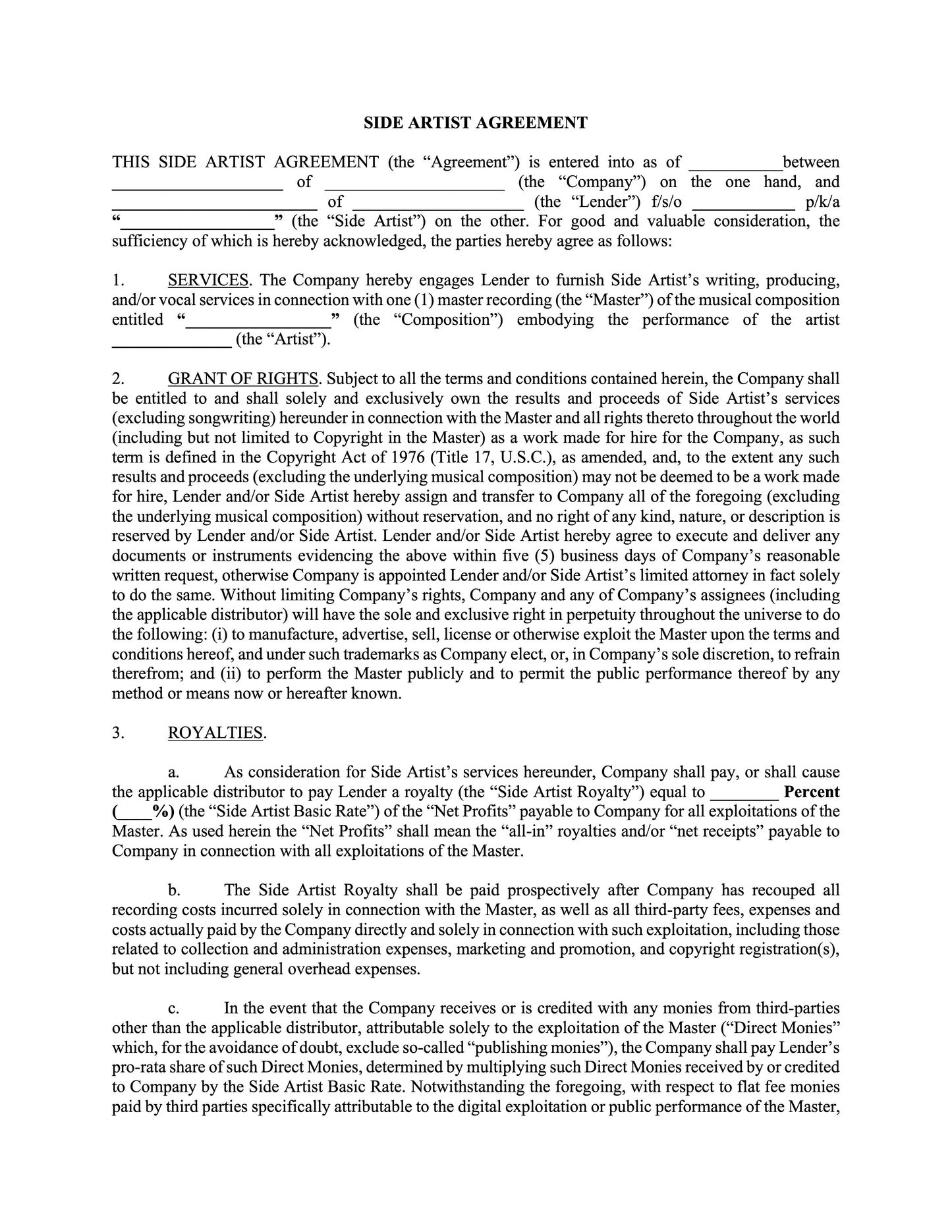
Featured Artist Agreement Template - Furnishing Company
Featured Artist Agreement Template - Furnishing Company
Couldn't load pickup availability
The featured artist has a loan-out company, which means you do not contract with the artist, you contract with their business entity. A featured artist agreement is the contract between the lead artist and a guest performer that sets what the guest is paid, who owns the recording, and what share of the composition they keep. This version is built for the furnishing company structure: the artist's LLC or corporation furnishes their services, signs the agreement, and represents that the artist will perform.
Written by Adam Freedman, a music attorney with more than 10 years of experience, admitted in New York.
Which featured artist agreement fits your deal?
The short answer: three versions, and what separates them is who signs and how much of the compensation is spelled out. The row highlighted below is this page.
| Template | Who signs | What the featured artist gets | Use it when |
|---|---|---|---|
|
Direct Artist Deal $20 |
The artist, personally | Royalty, an optional upfront fee, and a publishing share if they co-wrote | The artist has no company and is not signed elsewhere |
|
Furnishing Company $20 (this page) |
The artist's LLC or corporation | The same, paid to the company, with an inducement provision built in | The artist says "my company handles this" |
|
Royalty & Publishing Split $20 |
The artist, personally | A master royalty plus a defined publishing share, drafted in full | The publishing split is the negotiated point and you want those terms documented properly |
|
All three, inside the Vault $75 |
Whichever fits | All three versions, plus 24 other contracts | You do features regularly and want the right one on hand each time |
What's included
The furnishing company structure
- Furnishing company identification: the entity that furnishes the artist's services signs, with the artist named as the individual whose services are provided.
- Obligation of artist: the company represents and warrants that the artist will perform, binding the company rather than only the person.
- Artist acknowledgment provision: the inducement provision, where the individual artist agrees to be bound directly if the company fails to perform.
Compensation
- Royalty rate to company: the featured artist's royalty, paid to the furnishing company, as a percentage of net master receipts. Independent features commonly land in the 5 to 20% range depending on the guest.
- Advance or fee option: an upfront payment to the company, recoupable or not depending on the deal.
- Accounting schedule: quarterly or semi-annual, with statement and payment deadlines.
Publishing
- Composition ownership: if the guest contributed writing, their share is defined and directed to the company or the individual per their own arrangement.
- PRO registration: how shares are registered with ASCAP, BMI, or SESAC, and who makes sure the splits are correct on file.
Master recording rights
- Work for hire: the recorded performance is a work made for hire provided through the company, with a copyright assignment backup.
- Master ownership: you own the master. The company and the artist take royalties, not ownership.
- Delivery specs: file format, deadline, and technical requirements for the performance.
Representations & warranties
- Company authority: the company confirms it can enter the agreement and bind the artist to perform.
- No conflicting agreements: neither the company nor the artist is under anything that would block the feature.
- Clean contribution: no uncleared third-party elements inside the recorded contribution.
Credits, likeness & promotion
- Credit language: the required credit on DSPs, physical, and promo, using the artist's professional name.
- Likeness authorization: the grant to use the artist's name, image, and likeness to promote the track, subject to any approval rights negotiated.
- Promotional timing: when the featured artist may start posting on their own channels.
Common mistakes this template helps you avoid
Using a direct artist agreement when the artist has a loan-out: if the services are controlled by the entity, a direct agreement may not bind the right party, and the ambiguity surfaces exactly when someone needs to enforce it.
No inducement provision: if only the company signs and it later dissolves, you have no direct claim against the artist. The provision built into this template closes that gap without a separate document.
Master rights left ambiguous: even through an entity, the work-for-hire and assignment language is what creates clean chain of title on the recording.
Paying the wrong party: royalties go to the furnishing company, not the individual. The template names the payee and the accounting structure so the money lands where the tax reporting expects it.
Who this is for
- Indie labels working with established featured artists who require their entity to sign.
- Independent artists and producers collaborating with a guest who has formalized their business through an LLC or corporation.
- Music managers on the primary artist's side dealing with a guest's team that insists on a furnishing structure.
- Anyone doing a feature where the guest says "my company handles this." That is the signal to reach for this version rather than the direct one.
Frequently asked questions
How is this different from the Direct Artist Deal?
The Direct Artist Deal is used when the guest signs personally. This version is used when their business entity signs on their behalf. If their manager or attorney puts an entity name in the signature block, this is the one. If you are weighing whether to handle the deal yourself at all, what a music lawyer actually does is the honest version of that question.
What is an inducement letter and do I need one?
It is an acknowledgment from the individual artist confirming they are bound even though the company signed. It matters because a company can dissolve or go quiet, and without it your only counterparty disappears with it. This template builds that language in, so no separate document is needed.
Who receives the publishing, the company or the artist?
Depends on how the artist has structured it. Some hold publishing personally, some assign it to a publishing entity. The template handles both with a fill-in for the recipient. Confirm before finalizing, because a misdirected publishing share is slow and unpleasant to unwind.
What if their "company" is just a DBA?
A DBA is a trade name, not a separate legal entity, so there is nothing to sign. Use the Direct Artist Deal instead.
What if the compensation itself is the negotiation?
Then the Royalty & Publishing Split version drafts those terms in full rather than leaving them as fill-ins.
What format is the file delivered in?
Microsoft Word (.docx), editable immediately in Word, Google Docs, or Pages.
What happens after purchase
Instant download: Word (.docx) file delivered immediately after checkout.
Fully editable: fill in the furnishing company name, artist name, royalty rate, and all deal terms.
Attorney-drafted: furnishing structure, inducement provision, work for hire, and chain of title built in.
Reusable: covers every feature structured through a business entity.
Also available: the Direct Artist Deal for artists who sign personally, and the Royalty & Publishing Split for a fully drafted compensation structure.
Received an agreement you'd like to discuss? Send it over and we can go through it together.
Need more than one template? The Complete Music Contract Vault bundles 27 music contract templates for $75.
*DISCLAIMER: This template is provided as a starting point and does not constitute legal advice or create an attorney-client relationship. Furnishing company agreements involving significant advances, major label distribution, or complex loan-out structures should be reviewed by a qualified entertainment attorney before signing.
Share