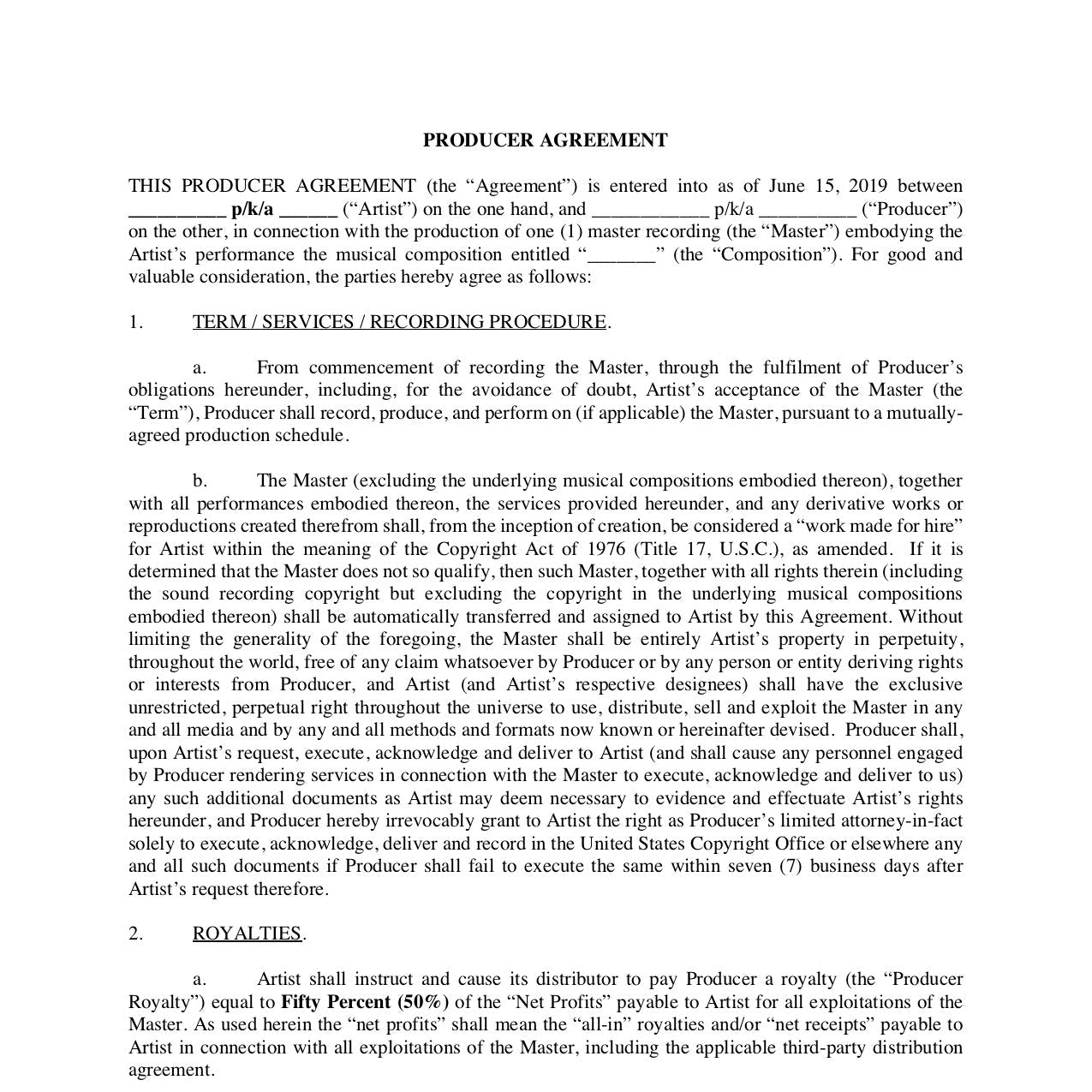
Producer Agreement Template - 50/50 Profit Split (No Advance)
Producer Agreement Template - 50/50 Profit Split (No Advance)
Couldn't load pickup availability
Not every producer deal involves an upfront check. Sometimes the producer believes in the project and wants in on the backend. A producer agreement is the contract between an artist and the producer of a track that sets what the producer is paid, who owns the master, and what share of the composition they keep. This 4-page template is built for the version where nobody pays anything upfront: no advance, no flat fee, but a 50/50 split on everything the song generates.
Written by Adam Freedman, a music attorney with more than 10 years of experience, admitted in New York.
Which producer agreement fits your deal?
The short answer: pick the row that matches how the producer gets paid. This page is the one where nobody pays upfront and everything is split down the middle. The row highlighted below is this page.
| Template | Upfront | What the producer gets on the back end | Use it when |
|---|---|---|---|
|
50/50 Profit Split (No Advance) $20 (this page) |
None | 50% of net profits and 50% of publishing | Nobody is paying upfront and you are splitting everything |
|
Advance + Publishing (No Royalty) $25 |
Advance | A publishing share, no master royalty | You want to pay once and keep the master royalty |
|
Advance + Royalty + Publishing $25 |
Recoupable advance | Master royalty and a publishing share | The standard placement deal, all three income streams |
|
Furnishing Company $25 |
Recoupable advance | The same three streams, paid to the producer's company | The producer signs through an LLC or loan-out |
|
Multi-Track $26 |
Advance, lump sum or per track | Royalty and publishing across every track in the project | One artist, several beats, one agreement instead of five |
|
Producer Agreement Bundle $75 |
Varies | All five structures above | You are not sure which one fits, or you do these deals regularly |
What's included
Ownership structure
- Work-for-hire master: the producer grants the artist full ownership of the master recording
- 50/50 publishing split: artist and producer share the composition equally
- 50/50 profit split: net profits from the song split equally
- A definition of "profit": exactly what gets deducted before the split, which is the clause the whole deal turns on
Rights & credits
- Producer credit requirements: how the producer is credited on releases and streaming metadata
- Grant of rights: what the producer grants the artist for distribution and exploitation
- Sample clearance responsibility: who handles clearing any samples and who pays for it
Legal protections
- Warranties and representations: both parties confirm they own what they say they own
- Indemnification: protection if a third party makes a claim against the work
- SoundExchange letter of direction: so the producer's share of digital performance royalties reaches them directly rather than sitting uncollected
Common mistakes this template helps you avoid
No written agreement: a verbal 50/50 means nothing once the song works and someone remembers it differently.
Undefined "profit": without a definition, one side can deduct everything and report that there is nothing to split. This is the single most common failure in profit-share deals.
No publishing documentation: without written proof of the split, the PROs do not know who to pay, and the money waits.
No sample clearance terms: who pays if a sample needs clearing has to be settled before release, not after a takedown.
No SoundExchange letter of direction: without it the producer's digital performance royalties go uncollected indefinitely.
Who this is for
- Producers who believe in a project and will work without an upfront advance.
- Independent artists working with a producer on a profit-share basis.
- Beatmakers collaborating directly with artists on original tracks.
- Any producer-artist partnership where both sides want equal backend participation.
Frequently asked questions
How is "profit" defined here?
Gross revenue minus the deductions you agree to: distribution fees, recording costs, and anything else you name. What you put on that list determines whether there is ever a split to make, so it is worth arguing about before signing rather than after.
Does the producer own the master?
No. The producer grants the artist master ownership as work for hire. Their compensation is the 50/50 profit split and the publishing share.
How is this different from the Advance + Royalty version?
The Advance + Royalty agreement pays upfront and gives backend points, commonly 3 to 5%. This one pays nothing upfront and gives a far larger backend share. Which fits depends on the deal and on how much either side believes in the record.
Can I change the split?
Yes. 50/50 is the default; 60/40 or any other split can be filled in. Uneven splits usually come with uneven control terms too, which is worth thinking through.
What if we sampled something?
The clearance responsibility clause says who handles it. Clearing it takes both the master recording license and the composition license, because a sample has two owners.
What format is the file delivered in?
Microsoft Word (.docx), editable immediately in Word, Google Docs, or Pages.
Not sure which version you need?
The free Producer Agreement Handbook explains every clause.
What happens after purchase
Instant download: Word (.docx) file delivered immediately after checkout
Fully editable: customize split percentages, deductions, and every other term
SoundExchange letter of direction included: so the producer's digital performance royalties reach them
Lifetime access: download anytime from your account
One-time payment: $20, no subscription
Part of the Producer Agreement Bundle (5 Agreements), all five producer deal structures for a single price.
Negotiating this one yourself? You don't have to. Hand it off.
Need more than one template? The Complete Music Contract Vault bundles 27 music contract templates for $75.
*DISCLAIMER: These templates are for informational purposes only, and purchasing them doesn't make us your lawyer. It's impossible to make one version that fits every situation, so you should contact a lawyer to make sure it fits yours.
Share