Music Sample Clearance Agreement Template - Composition
Music Sample Clearance Agreement Template - Composition
Couldn't load pickup availability
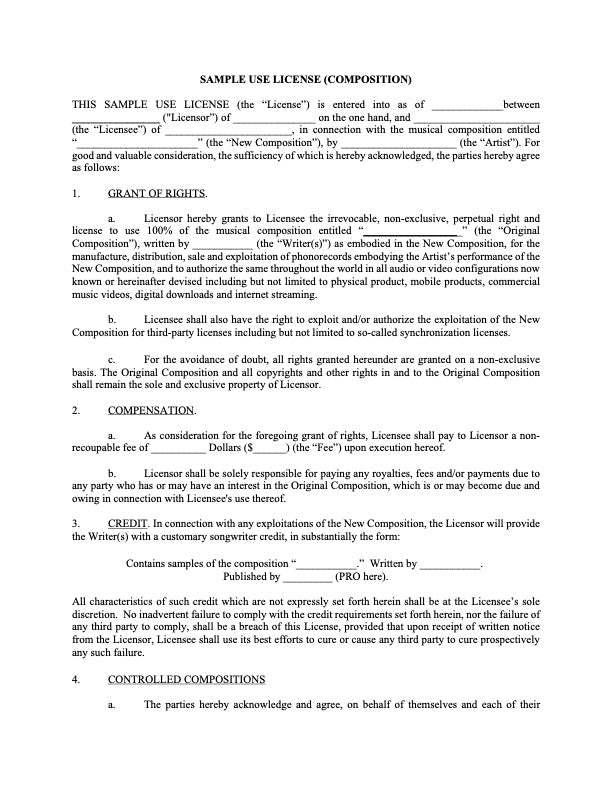
You sampled someone's song, their composition, their melody, their lyrics, and now you need to clear it before anyone hears your track. A sample clearance agreement is the written license from a copyright owner permitting you to use part of their work in a new recording. This one handles the publishing side: it licenses the underlying musical work from whoever controls it, usually the publisher or songwriter, sets the fee or royalty, and gives you documented authorization to use the composition in your track.
Written by Adam Freedman, a music attorney with more than 10 years of experience, admitted in New York.
Which sample clearance do you need?
The short answer: every sample has two sides and they are cleared separately, so most released samples need both of these. The row highlighted below is this page.
| Template | What it clears | Who signs it with you | When you need it |
|---|---|---|---|
|
Composition $24 (this page) |
The underlying song: melody, lyrics, arrangement | The songwriter or their publisher | Always, including an interpolation you re-recorded yourself |
|
Master Recording $20 |
The specific recording you lifted | The label, producer or whoever owns the master | Whenever you used the original recording instead of replaying it |
|
Both, inside the Vault $75 |
Both sides, plus 25 other contracts | Both rights holders | Most released samples need both, so this is usually the answer |
What's included
Understanding sample clearance: two sides
- Composition vs. master: every recorded sample requires two separate clearances: the composition, meaning the melody, lyrics and arrangement, and the master recording, meaning the specific recorded version you sampled. This template clears the composition side only. For the other side, see the Master Recording Sample Clearance Agreement.
- Who owns the composition: typically the songwriters and their publisher. This agreement is executed with whoever controls the publishing rights, which is often not the artist you associate with the song.
License grant
- Description of sample: identifies the original composition being licensed, including song title, songwriters, and publisher, and describes the portion being sampled.
- Description of new work: identifies your track, your artist name, and the intended release format.
- License scope: a non-exclusive license to use the sampled composition in your new recording. The copyright owner keeps everything else.
- Territory: worldwide, or limited to specific territories if your release is regional.
- Term: perpetual, which is standard for cleared samples, or time-limited if that is what was negotiated.
Compensation
- Flat fee option: a one-time upfront payment, most common for smaller independent releases.
- Royalty option: the copyright owner takes a percentage of publishing income from your new work, common when the sample carries a significant part of the composition.
- Co-publishing option: for when the owner insists on a share of the new composition's copyright rather than a fee.
- Minimum guarantee: optional minimum payment regardless of whether royalty thresholds are met.
Usage restrictions & approvals
- Permitted uses: how the new recording can be released and exploited: streaming, downloads, sync, physical, live performance.
- Approval over new recording: whether the licensor gets to hear and approve the final version before release.
- Modification restrictions: any limits on how the sampled portion can be altered, filtered, or built into the new work.
Credit & attribution
- Credit line: the required songwriter credit and copyright notice, for example "Contains a sample of '[Song Title]' written by [Songwriter], published by [Publisher]".
- PRO credit: how the sampled composition's share shows up in your work's PRO registration and royalty statements.
Standard legal protections
- Warranties: the licensor confirms they control the composition and have authority to grant the license.
- Indemnification: protection for both parties against claims arising from each side's representations.
- Governing law: your choice of jurisdiction, enforceable across all U.S. jurisdictions.
Common mistakes this template helps you avoid
Releasing with an uncleared sample: platforms routinely take music down for it, and publishers monitor DSPs and file claims, with statutory damages reaching $150,000 per work for willful infringement.
Assuming one clearance covers both sides: clearing the composition does not clear the master, and the reverse is equally true. Commercial release generally needs both.
No credit language: most sample licenses require specific credit in metadata, liner notes, and streaming profiles. Missing it can void the license or trigger a fresh claim.
Verbal clearance from the artist: the artist usually does not control the composition, their publisher does. "Sure, use it" from someone who assigned their publishing is worth nothing.
Who this is for
- Producers and beatmakers who sampled a recognizable composition and need documented clearance before distribution.
- Independent artists releasing music that interpolates or directly samples someone else's melody or lyrics.
- Indie labels needing clean licensing documentation in the chain of title before distribution agreements are signed.
- Music supervisors clearing samples inside tracks being licensed for TV, film, or advertising, where full chain of title is required.
Frequently asked questions
How is this different from the Master Recording clearance?
This clears the underlying song, owned by the songwriter and publisher. The Master Recording template clears the specific recorded version, owned by the label or master owner. A commercial release with a lifted sample generally needs both. An interpolation you re-recorded needs only this one. If you are still working out what your track needs, your sampling questions, answered walks through the common situations.
How do I find out who owns the composition?
Search the ASCAP, BMI, and SESAC databases, all public. For older works check the Copyright Office records at copyright.gov. Publisher information also surfaces through mechanical licensing services.
What if the publisher will not clear it?
Remove the sample, or replay it as an interpolation, which drops the master clearance requirement but still needs this one. No template can compel a license. This one documents a license that has already been agreed.
Does an interpolation need this?
Yes. Re-recording a portion yourself avoids the master side but not the composition. That is the most commonly misunderstood point in sampling.
Do I need both clearances even for a very short sample?
Length is not a safe harbor. There is no reliable rule that some number of seconds or notes is free, and rulings have gone in different directions on short samples. If it is recognizable, treat it as needing clearance.
What if the publisher never responds?
Silence is not permission, and releasing anyway is the choice that turns a fee negotiation into an infringement claim. Documented attempts help, but they do not substitute for a license. At that point the question is whether to escalate or replace the sample.
What format is the file delivered in?
Microsoft Word (.docx), editable immediately in Word, Google Docs, or Pages.
What happens after purchase
Instant download: Word (.docx) file delivered immediately after checkout.
Fully editable: fill in song titles, publisher names, the license fee, and deal-specific terms.
Attorney-drafted: covers flat fee and royalty structures, with the credit language publishers usually require.
Reusable: use it for every composition clearance you execute.
Also available: the Music Sample Clearance Agreement - Master Recording to clear the other side of the sample.
Bigger than a template? Some clearances need a lawyer reading the actual paper. Book a consult.
Need more than one template? The Complete Music Contract Vault bundles 27 music contract templates for $75.
*DISCLAIMER: This template is provided as a starting point and does not constitute legal advice or create an attorney-client relationship. Sample clearance involves complex copyright questions. For high-profile samples, significant releases, or samples where the licensor is unresponsive, consult a qualified entertainment attorney before proceeding.
Share