The Royalty Recovery System: How to Collect Unpaid Producer Royalties (Without Hiring a Lawyer Yet)
The Royalty Recovery System: How to Collect Unpaid Producer Royalties (Without Hiring a Lawyer Yet)
Couldn't load pickup availability
You did the work. The track dropped. You are still waiting to get paid. The Royalty Recovery System is a 47-page guide plus two editable Word files that walk a producer through collecting an unpaid fee or unpaid backend royalties in writing, from the first polite follow-up to a formal demand letter, before anyone files anything.
Written by Adam Freedman, a music attorney with more than 10 years of experience, admitted in New York. Built from real payment situations rather than theory.
Where are you in this?
The short answer: if the money is already late and you are being stalled, this guide is the right starting point. If you have not sent paper yet, start free. The row highlighted below is this page.
| Your situation | What you actually need | Start here |
|---|---|---|
| The work is done but you never sent a bill | A clean invoice with terms on it, so the clock starts |
Producer Invoice Template Free |
| There is no signed agreement at all | Paper for the next deal, and a starting point for this one |
Producer Agreement Bundle $75 |
| You invoiced and you are being stalled, ghosted, or paid an amount that looks wrong | A written escalation sequence, the reply to each stall, and a demand letter |
The Royalty Recovery System $39 (this page) |
| You have escalated in writing, been ignored, and the amount is significant | Someone reading the actual paper and telling you what the claim is worth | A consult |
Why payments get stuck
Maybe it has been three weeks. Maybe it has been a year. Either way you are doing the thing every producer does: following up politely, not wanting to seem difficult, while the invoice sits at the bottom of somebody's inbox.
Nobody in the music industry is thinking about your unpaid royalties. Silence works in their favor, not yours. And most stuck payments are not theft. They are a systems problem: the wrong entity was invoiced, the split was never registered, the advance is sitting unrecouped, or the person who agreed to the number no longer works there. Systems problems have fixes, and the fixes are written, dated, and specific.
Inside the 47-page guide
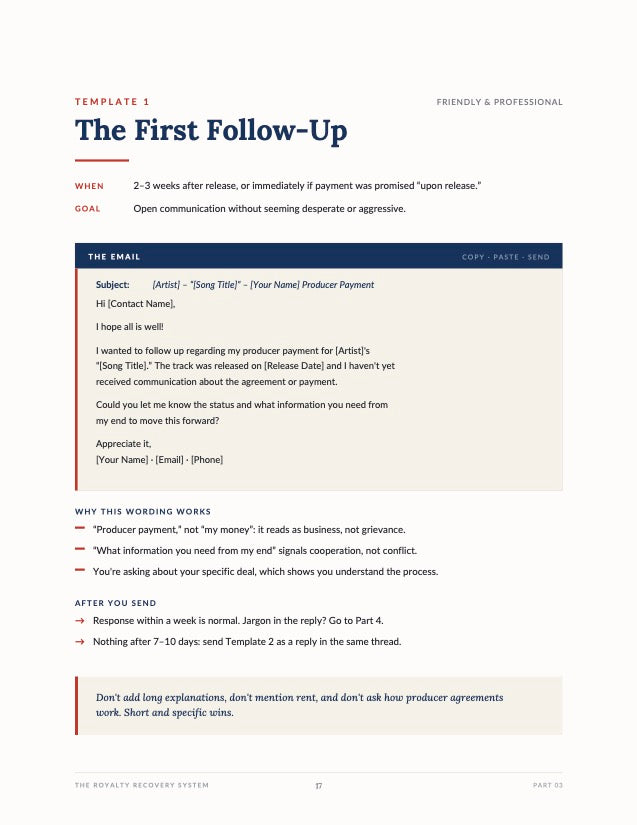
- 8 copy-paste email templates that escalate from friendly follow-up to formal notice, with the exact wording that forces a real answer
- The jargon decoder: what "it's in recoupment," "you'll get your points," and "accounting is processing it" actually mean, and the reply that ends each stall
- The 7 reasons producer payments get stuck, with a different fix for each one
- An annotated royalty statement, so you can see line by line where the money goes missing and ask the three questions that make them show their work
- A fill-in demand letter: the formal step before litigation, with a pre-send checklist
- Your leverage, mapped: album rollouts, charting tracks, takedown rights, and the five moments when you hold the cards
- Trackers, a follow-up schedule, and an honest diagnostic that tells you whether a payment is even worth chasing
- The prevention checklist, so the next deal never needs any of this
You also get two editable Word files: all 8 email templates ready to fill in and send, and the demand letter template.
Who this is for
- Producers and beatmakers: owed a fee, an advance, or backend royalties on a released record
- Anyone being stalled or ghosted: by a label, a manager, an artist, or an accounting department that stopped replying
- Anyone paid an amount that looks wrong: where the statement arrived but the number does not match what was agreed
- Managers and business managers: chasing payment on behalf of a client and wanting a documented paper trail rather than another phone call
No signed contract? There is a starting point inside for that too.
Common mistakes this guide helps you avoid
Chasing by text and DM: an untimed, undated, unsearchable trail is worth very little later. Every step in this system is written, dated, and specific about the amount owed.
Accepting "it's in recoupment" at face value: recoupment is a defined mechanic in a contract, not a mood. The guide gives you the question that makes the other side state which income streams they are recouping from, and from what balance.
Sending an angry email as the first escalation: the sequence exists because the order matters. A demand letter lands very differently after three documented, professional follow-ups than it does cold.
Waiting too long: claims for unpaid money do not stay available forever, and the limitations period varies by state and by the kind of claim. If the debt is old, that is a reason to move now rather than a reason to give up quietly.
Frequently asked questions
Do I need a signed contract for this to be useful?
No. A signed agreement makes the claim cleaner, but emails, invoices, session files, credits, and a course of dealing are all evidence of a deal. The guide includes a starting point for producers working without paper, and the Producer Agreement Bundle covers the next one so this does not repeat.
Is this a substitute for hiring a lawyer?
No, and it is not meant to be. It is the set of written steps that come before a lawyer is worth the cost, which for most independent-level amounts is where the matter actually resolves. If those steps run out, you will have a documented record that makes the legal conversation much shorter.
Will this work if the label is overseas or is a distributor rather than a label?
The escalation sequence is the same. Who you send it to changes, and the guide covers identifying the entity that actually holds the money, which is often not the person who booked you.
What if I was paid but the statement looks wrong?
That is the annotated royalty statement section. It walks through where deductions typically hide, which lines to question, and the three questions that force a payor to show their calculation.
I am not sure it is time to escalate yet.
Start with the free post on what to do if you have not been paid for a placement, which covers the first two moves. If you have already made them and nothing happened, this guide is the next step.
What format are the files delivered in?
The guide is a PDF. The email templates and the demand letter are Microsoft Word (.docx) files, editable immediately in Word, Google Docs, or Pages.
What happens after purchase
Instant download: the 47-page PDF and both Word files delivered immediately after checkout.
Fully editable: fill in names, dates, and amounts in the email templates and the demand letter.
Attorney-drafted: the sequence and the letter are the ones used in real producer payment situations.
Reusable: $39 once, and the templates work for every payment you chase after this one.
Working through terms you don't recognize? A short call is usually enough to know where you stand. Set one up.
Want the next deal papered properly? The Complete Music Contract Vault bundles 27 music contract templates for $75, including all five producer agreement structures.
Educational materials only. Not legal advice, and purchasing does not create an attorney-client relationship with the Law Office of Adam C. Freedman, PLLC. Examples are illustrative. Attorney advertising.
Share