Producer Agreement Template - Advance & Publishing (No Royalty)
Producer Agreement Template - Advance & Publishing (No Royalty)
Couldn't load pickup availability
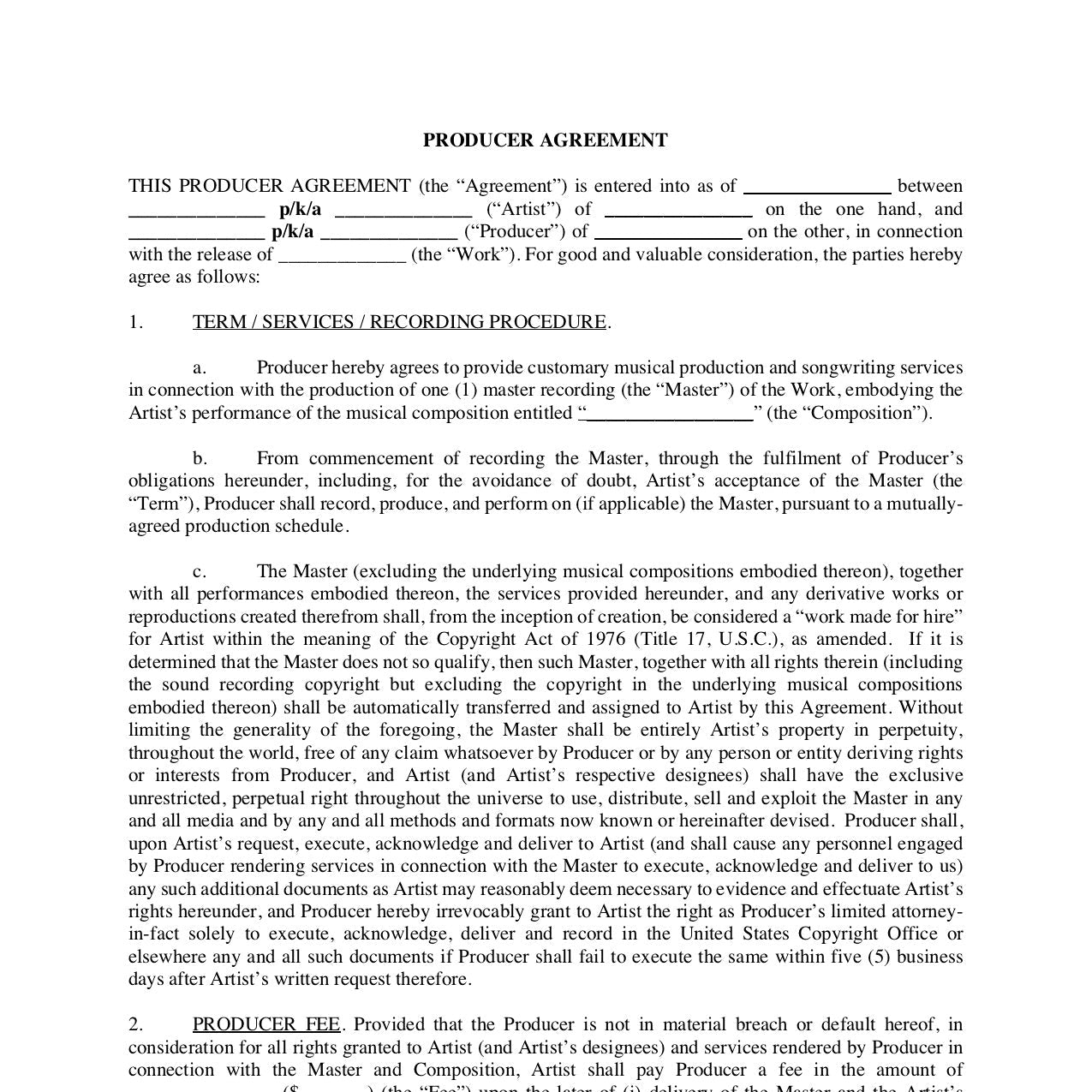
You gave the producer an advance and a piece of your publishing. Now lock the deal in writing before anyone presses record. A producer agreement is the contract between an artist or label and the producer of a recording that sets what the producer is paid, who owns the master, and what share of the composition they keep. This version pays the producer upfront and gives them a publishing share, with no backend royalty on the master.
Written by Adam Freedman, a music attorney with more than 10 years of experience, admitted in New York.
Which producer agreement fits your deal?
The short answer: pick the row that matches how the producer gets paid. This page is the one where you pay once and keep every dollar of master royalty. The row highlighted below is this page.
| Template | Upfront | What the producer gets on the back end | Use it when |
|---|---|---|---|
|
50/50 Profit Split (No Advance) $20 |
None | 50% of net profits and 50% of publishing | Nobody is paying upfront and you are splitting everything |
|
Advance + Publishing (No Royalty) $25 (this page) |
Advance | A publishing share, no master royalty | You want to pay once and keep the master royalty |
|
Advance + Royalty + Publishing $25 |
Recoupable advance | Master royalty and a publishing share | The standard placement deal, all three income streams |
|
Furnishing Company $25 |
Recoupable advance | The same three streams, paid to the producer's company | The producer signs through an LLC or loan-out |
|
Multi-Track $26 |
Advance, lump sum or per track | Royalty and publishing across every track in the project | One artist, several beats, one agreement instead of five |
|
Producer Agreement Bundle $75 |
Varies | All five structures above | You are not sure which one fits, or you do these deals regularly |
Why this structure, and when it fails
Trading publishing for the master royalty is a real bargain, not a discount. The artist keeps every dollar the recording earns, which over a catalog is the larger number. The producer takes a share of the song, which pays out through a different pipe and keeps paying long after the recording stops moving.
It works when the producer built the musical bed and the artist intends to own the record outright. It stops working when the producer has leverage. A producer with placements will want the master royalty as well, and this template is not the one they will sign. That is the Advance + Royalty + Publishing version.
Worth being honest about the other direction too. If the producer contributed nothing to the composition and only arranged an instrumental, giving away a publishing share may cost you more over twenty years than the royalty points you were trying to protect.
What's included
Compensation structure
- Advance amount and payment schedule: how much the producer gets and when, commonly half on signing and half on delivery.
- Recoupable or not: whether the advance recoups from future income, and which income is excluded.
- No royalty clause: an explicit provision that the producer takes no percentage of master receipts. Without it, "the producer will be compensated" is an opening for a royalty claim later.
Publishing split
- Composition ownership: the producer's share of the song, commonly 25%, 33%, or 50%.
- PRO registration: how the split is filed with ASCAP, BMI, or SESAC, and who is responsible for filing it.
- Publishing administrator: who administers the composition, whether that is the producer's publisher, yours, or a third party.
Master recording rights
- Master ownership: the artist keeps 100% of the recording.
- Work for hire: the producer's contribution is work made for hire, with a copyright assignment as backup.
- Delivery requirements: stems, final mix, session files, and the deadline for each.
Creative and commercial terms
- Producer credit: the required wording for streaming, physical, and promotional use.
- Approval rights: whether the producer approves the final mix, featured artists, or release format.
- Exclusivity: whether the beat is yours alone or the producer can license it elsewhere.
- Release deadline: an optional clause requiring you to release within a set window.
Standard protections
- Warranties and representations: the producer owns the beat and it infringes nothing.
- Indemnification: mutual, for copyright claims and breach of warranty.
- Governing law: you choose the state.
- Signature block: works for wet and electronic signature.
Common mistakes this template helps you avoid
Giving the producer royalties by accident. A vague contract that promises the producer will be "compensated" leaves room for a royalty claim once the record earns. The no-royalty clause closes it.
Agreeing to a publishing split without saying which half. Publishing has a writer's share and a publisher's share. "You get 50% of the publishing" means two different numbers depending on which one you meant, and the PRO will not resolve it for you.
Leaving the master unsecured. Composition and recording are separate copyrights. Handling the publishing does nothing about the master, and a producer with no work-for-hire clause can claim co-ownership of the recording.
Skipping PRO registration language. When both sides file different splits, the money sits with the PRO until somebody produces a signed document.
Who this is for
- Independent artists who paid an advance and agreed to a publishing cut but intend to keep all master income.
- Indie labels retaining 100% of master receipts and using publishing to make the deal attractive.
- Artist-entrepreneurs releasing independently who want an enforceable producer agreement without a label legal department.
- Music managers formalizing producer relationships before recording starts.
Frequently asked questions
How is this different from the 50/50 Profit Split version?
The 50/50 Profit Split version gives the producer half of net profits from the recording and pays nothing upfront. This one pays upfront and gives publishing only, with no participation in master income at all.
Can I change the publishing percentage?
Yes, it is bracketed. 25%, 33%, and 50% are the common landing spots. Where you land should track what the producer actually contributed to the song rather than what feels fair in the moment.
Does this work for a beat bought online?
Sometimes. Read the beat license you already signed first. Many of them carry royalty provisions that contradict the no-royalty structure here, and the earlier document usually wins.
What if the producer co-wrote the lyrics?
Then the publishing split needs to account for that separately. This template addresses the producer's contribution as a beatmaker. Lyric co-writing belongs in a songwriter agreement.
Is it state-specific?
No. You fill in the governing law clause with your state.
What format is the file delivered in?
Microsoft Word (.docx), editable immediately in Word, Google Docs, or Pages.
What happens after purchase
Instant download: a Word (.docx) file immediately after checkout. No waiting, no account setup.
Fully editable: fill in names, dates, advance amount, publishing split, and deal-specific terms.
Attorney-drafted: usable as-is or customized without losing legal integrity.
Reusable: use it for every producer deal you do on this structure.
Part of the Producer Agreement Bundle (5 Agreements), all five producer deal structures for a single price.
Not sure this template covers your situation? Ask before you sign, not after.
New to producer deals? Read the free producer agreement guide before you sign.
Need more than one template? The Complete Music Contract Vault bundles 27 music contract templates for $75.
*DISCLAIMER: This template is provided for informational purposes and as a starting point for your legal agreements. It does not constitute legal advice and does not create an attorney-client relationship. For complex deals, significant advances, or major label involvement, consult a qualified entertainment attorney before signing.
Share