Music Collaboration Agreement Template - 50/50 Split
Music Collaboration Agreement Template - 50/50 Split
Couldn't load pickup availability
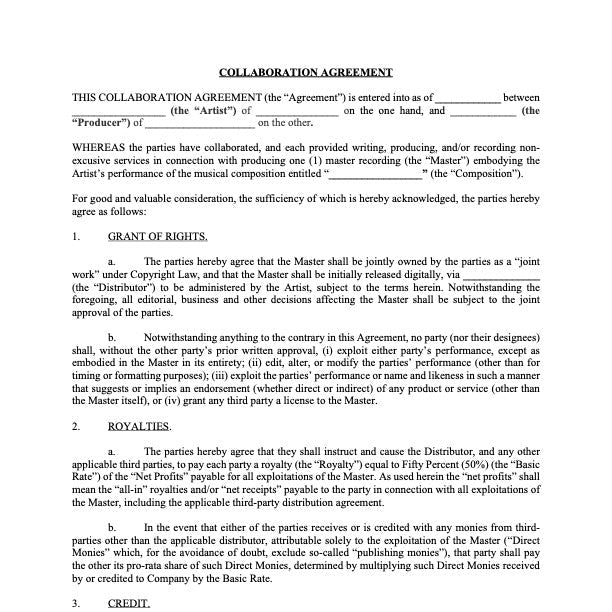
Two artists, one song, no contract. That is how catalog disputes start. A music collaboration agreement is the contract between two creators who build something together as equal partners, setting out that they own the master 50/50, own the publishing 50/50, and neither one can license the song without the other. This is a 3-page version covering ownership, revenue, credit, and the sample question.
Written by Adam Freedman, a music attorney with more than 10 years of experience, admitted in New York.
Which business agreement do you need?
The short answer: this one when you are true equal partners on the track. If one of you is hiring the other, it is a producer or featured artist deal instead. The row highlighted below is this page.
| Agreement | The relationship | Who ends up owning what |
|---|---|---|
|
Music Collaboration Agreement $20 (this page) |
Two creators as equal partners on a track | 50/50 of the master and 50/50 of the publishing |
|
Producer Agreement $25 |
Artist or label engages a producer | Artist owns the master, producer takes a royalty and publishing share |
|
Songwriter Co-Writer Split $18 |
Two or more writers on the composition only | Defined publishing shares, master handled separately |
|
Featured Artist Agreement $20 |
One artist guests on another artist's record | Host owns the master, guest takes a defined percentage |
|
Complete Music Contract Vault $75 |
Every deal type in the shop | One purchase, all of it |
What's included
Ownership & rights
- 50/50 master ownership: both parties share equal ownership of the master recording
- 50/50 publishing split: both parties share equal ownership of the underlying composition
- Equal decision-making: neither party can license or exploit the song without the other's consent
- Credit requirements: how both parties are credited on releases and streaming metadata
Revenue & royalties
- Revenue split structure: how income from the collaboration is divided
- Streaming and sync income: each party receives their equal share of every form of exploitation
- PRO registration: each party registers their own publishing share with their own PRO
Legal protections
- Warranties and representations: each party confirms they own what they are contributing
- Sample clearance responsibility: who is on the hook for clearing anything sampled in the track
- Indemnification: protection if a third party makes a claim against the collaboration
Common mistakes this template helps you avoid
"We both own it" with nothing in writing: that phrase means nothing once the song earns, and the person with the DistroKid login usually ends up controlling the outcome.
Unclear decision rights: one party licenses the track for a sync without telling the other, and now there is a deal neither of you can cleanly unwind.
No PRO registration terms: unregistered shares are uncollected royalties, and they stay uncollected for years.
Silence on samples: if the track cannot be released until a sample is cleared, the agreement should say who is doing that and who pays.
Undefined credit: streaming platforms and distributors need to know exactly how to credit both parties, and metadata is very hard to fix after release.
Who this is for
- Artists and producers collaborating on original tracks as genuine equal partners.
- Co-producers working together on a joint project.
- Songwriters and beatmakers splitting both master and publishing down the middle.
- Independent creators formalizing a collaboration before it generates income, which is the only easy time to do it.
Frequently asked questions
How is this different from a producer agreement?
A producer agreement gives the artist ownership of the master and pays the producer points. This gives both parties equal ownership of everything. It is for partnerships, not hire-for-service.
Can we use it with a split other than 50/50?
It is drafted for 50/50. Any other split can be edited in, but uneven splits usually come with uneven control terms too, which is worth getting right rather than just changing a number.
What if only the publishing is shared, not the master?
Then you want the Songwriter Agreement for a co-writer publishing split, which handles the composition on its own.
Who registers the song with the PROs?
Each party registers their own share with their own PRO. The template makes that responsibility explicit so neither of you assumes the other did it.
Can either of us license the song independently?
No. Both parties must consent to any license or exploitation, which is the provision that protects each of you from the other.
What if we sampled something?
The clearance responsibility clause says who handles it. Clearing it takes both a master recording license and a composition license, because a sample has two owners. This post on what a music lawyer actually does covers when that gets complicated.
What format is the file delivered in?
Microsoft Word (.docx) and PDF, editable immediately in Word, Google Docs, or Pages.
What happens after purchase
Instant download: Word (.docx) and PDF files delivered immediately after checkout
Fully editable: customize every term to fit your collaboration
Lifetime access: download anytime from your account
One-time payment: no subscription
Want a second set of eyes before you sign? That's what a consult is for.
Need more than one template? The Complete Music Contract Vault bundles 27 music contract templates for $75.
*DISCLAIMER: These templates are for informational purposes only, and purchasing them doesn't make us your lawyer. It's impossible to make one version that fits every situation, so you should contact a lawyer to make sure it fits yours.
Share