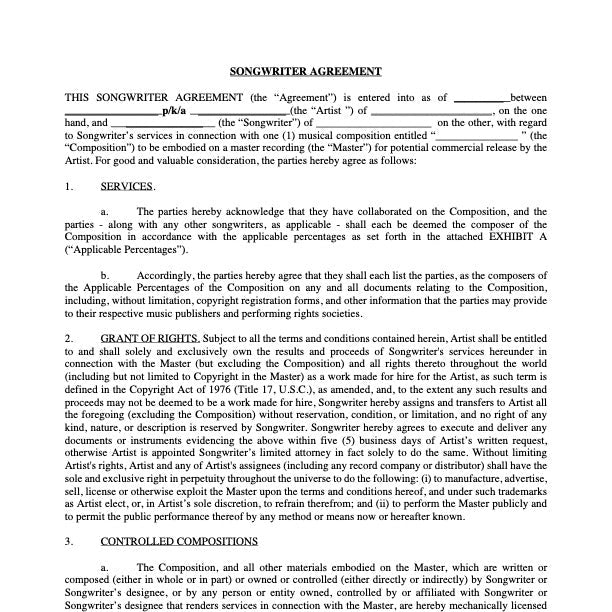
Songwriter Agreement Template - Co-Writer Publishing Split
Songwriter Agreement Template - Co-Writer Publishing Split
Couldn't load pickup availability
Someone helped you write the song, and now they're entitled to a share of everything that song earns, for the rest of the copyright. A co-writer publishing split agreement is the document that records what percentage of a composition each writer owns, so the performing rights organizations pay the right people in the right amounts. This template is built for the most common co-writing situation: two or more people wrote the song together, the splits need to be documented, and everyone needs clarity on what they own before the track goes near a distributor, publisher, or sync agent.
Written by Adam Freedman, a music attorney with more than 10 years of experience, admitted in New York.
Which songwriter agreement fits your situation?
The short answer: if both sides are people, use this one. If one side is a company, use the other. The row highlighted below is this page.
| Template | Who the parties are | What it settles | Use it when |
|---|---|---|---|
|
Co-Writer Publishing Split $18 (this page) |
Two or more individual writers | Each writer's percentage of the composition and how it gets registered | You wrote the song with someone and need the split on paper before anyone registers it |
|
Company & Songwriter $20 |
A business entity and an individual writer | What the writer delivers, what each side owns, and who administers it | A label, publisher or artist's LLC is commissioning or documenting the writing |
|
Both, inside the Vault $75 |
Whichever the situation calls for | Both, plus 25 other contracts | You write with different people regularly and need the right paper each time |
What's included
Defining the composition
- Song identification: title, alternative titles, and a description of each writer's contribution: melody, lyrics, chord structure, arrangement.
- Contribution acknowledgment: each co-writer confirms the nature and extent of what they brought, which is the factual basis the split rests on.
- Date of creation: when the composition was written and completed, which matters for registration and for any prior claim.
Publishing split
- Ownership percentages: each writer's share stated as a percentage totaling 100%. Equal splits, contribution-weighted splits, whatever you agreed.
- Writer's share vs. publisher's share: how the total breaks down between the share PROs pay writers directly and the share paid to publishers.
- Publisher identification: if a writer has a publishing company or administrator, that entity is named and their share flows accordingly.
PRO registration
- Registration obligations: who registers the composition with ASCAP, BMI, or SESAC, and how each writer registers their own share.
- Conflicting registration prevention: the provisions that stop two writers filing different splits, which is one of the most common and most expensive mistakes in independent music.
- Mechanical licensing: how mechanicals are collected and distributed among the writers, including an administrator's role if there is one.
Administration rights
- Independent administration: the default, where each writer can license their own share, subject to customary limits.
- Joint approval option: the alternative, requiring all writers to approve certain uses such as sync, interpolations, and advertising.
- Accounting between co-writers: if one writer collects for everyone, what they owe the others and when.
Copyright registration
- Copyright Office registration: whether the writers register jointly and who pays for it.
- Ownership of copyright: confirms joint ownership in the stated percentages, with no writer able to exclude the others from the composition.
Standard legal protections
- Warranties: each writer confirms their contribution is original and contains no uncleared samples.
- Indemnification: mutual protection if one writer's contribution turns out to infringe.
- Governing law: your choice of state, enforceable across all U.S. jurisdictions.
Common mistakes this template helps you avoid
No split agreement before registration: once a song is registered with one split, correcting it afterward is slow and can freeze payments for months.
Two writers registering different splits: the PRO holds all royalties in suspense until the conflict is resolved. A signed agreement is what resolves it.
No sync approval rule: without a joint approval clause, one writer can license the song into an advertisement you would never have agreed to, and you have no basis to stop it.
Undocumented contribution: years later, when the song is worth something, memories improve. A written agreement signed at the time is the only reliable record of who did what.
Who this is for
- Songwriters who co-write in the studio, over email, or in a writing camp.
- Artists who write with their producers where the producer contributed melody or musical elements, not just production.
- Producers who write toplines or melodies and want composition ownership documented separately from their producer deal.
- Publishers and administrators onboarding co-written works and needing a clean split before issuing licenses.
Frequently asked questions
How do co-writers split publishing?
It is negotiated, and it should reflect contribution. Equal splits are common even when contributions are not perfectly equal, because they are simple and avoid arguments. Contribution-weighted splits exist too. Whatever you land on has to be written down and registered with your PRO, or nobody gets paid correctly.
Does this cover the master recording?
No, the composition only. Master ownership is a separate document, usually a producer agreement or a recording agreement.
What if one co-writer is signed to a publishing deal?
Their share may vest automatically in their publisher under that deal. That is worth reading before anyone signs a split agreement, because it changes who actually receives the money.
How is this different from the Company & Songwriter version?
This one is between individual writers. The Company & Songwriter version is for when a label, publisher, or artist's entity is on one side. Both parties people, use this. One side a business, use that. If you are weighing whether to handle the split yourself at all, what a music lawyer actually does is the honest version of that question.
The producer made the beat but says they are not a songwriter. Are they?
That depends on what they contributed. Original musical elements with enough creativity, including arrangement and melodic material, can amount to authorship of the composition regardless of what anyone calls it. It is worth settling before the song earns rather than after.
What format is the file delivered in?
Microsoft Word (.docx), editable immediately in Word, Google Docs, or Pages.
What happens after purchase
Instant download: Word (.docx) file delivered immediately after checkout.
Fully editable: fill in writer names, percentages, PRO affiliations, and administrator information.
Attorney-drafted: PRO registration provisions, joint approval clauses, and indemnification built in.
Reusable: use it for every co-written song in your catalog.
Also available: the Songwriter Agreement - Company & Songwriter if one of the parties is a business entity.
Have a deal in front of you right now? Bring it to a consult.
Need more than one template? The Complete Music Contract Vault bundles 27 music contract templates for $75.
*DISCLAIMER: This template is provided as a starting point and does not constitute legal advice or create an attorney-client relationship. Publishing splits involving significant catalog value, existing publisher relationships, or international rights should be reviewed by a qualified entertainment attorney before the agreement is executed.
Share