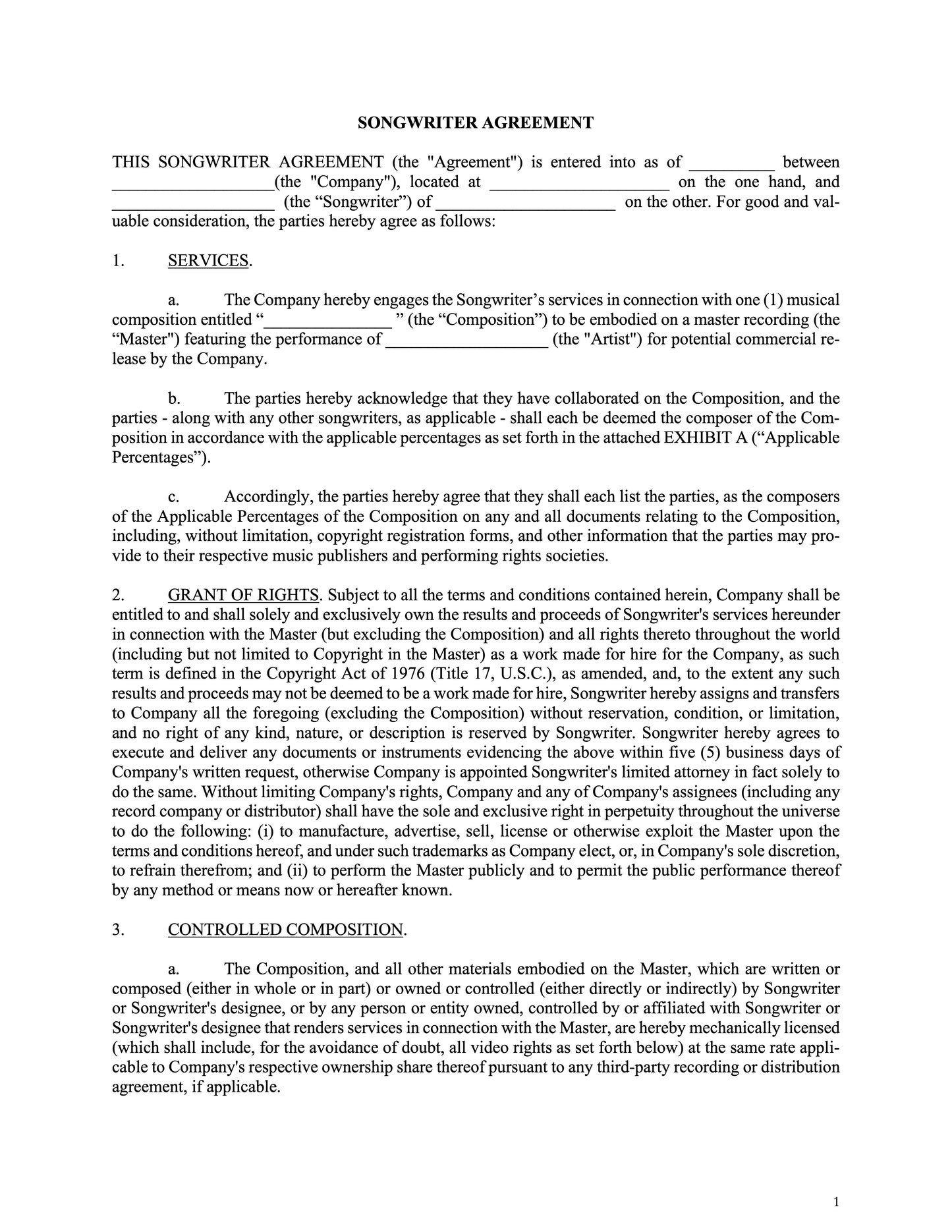
Songwriter Agreement Template - Company & Songwriter
Songwriter Agreement Template - Company & Songwriter
Couldn't load pickup availability
When a label, publishing company, or artist's business entity commissions a songwriter to write, or retroactively documents a co-write, this is the agreement that governs the relationship. A company and songwriter agreement is the contract between a business entity and an individual writer that sets what the songwriter delivers, what share of the composition each side owns, and who has the authority to license it. This template is structured for exactly that: one party is a business entity, and the other is an individual songwriter.
Written by Adam Freedman, a music attorney with more than 10 years of experience, admitted in New York.
Which songwriter agreement fits your situation?
The short answer: if one side is a company, use this one. If both sides are people, use the other. The row highlighted below is this page.
| Template | Who the parties are | What it settles | Use it when |
|---|---|---|---|
|
Co-Writer Publishing Split $18 |
Two or more individual writers | Each writer's percentage of the composition and how it gets registered | You wrote the song with someone and need the split on paper before anyone registers it |
|
Company & Songwriter $20 (this page) |
A business entity and an individual writer | What the writer delivers, what each side owns, and who administers it | A label, publisher or artist's LLC is commissioning or documenting the writing |
|
Both, inside the Vault $75 |
Whichever the situation calls for | Both, plus 25 other contracts | You commission writing regularly and need the right paper each time |
What's included
The company-songwriter structure
- Party identification: the company as contracting entity, label, publisher, production house, or artist's LLC, with the individual songwriter as the other party.
- Nature of engagement: whether the writer is engaged for one song, an album project, an ongoing relationship, or to formalize an existing co-write after the fact.
- Songwriting contribution: what the writer delivers, lyrics only, music and lyrics, a topline, or a full composition, and for which project.
Ownership & publishing split
- Composition ownership: each party's percentage of the composition based on contribution and negotiation.
- Publishing administration: who administers, whether each side handles their own or the company administers the whole composition under a co-publishing or administration deal.
- Writer's share protection: confirms the writer's share, paid directly by the PROs, stays with the songwriter and is not assigned away.
Compensation
- Flat fee option: a work-for-hire fee paid upfront, in addition to or instead of a publishing split.
- Royalty participation: if the writer participates in backend, what they take from the company's share of publishing income.
- Advance against royalties: an optional recoupable advance, with accounting and recoupment terms.
PRO registration & mechanical rights
- Registration obligations: who registers with ASCAP, BMI, or SESAC, and how each share appears in the registration.
- Mechanical licensing: how mechanicals are collected and distributed, including whether an administrator is handling collection.
- Sync licensing approval: whether the writer approves placements or the company can license independently.
Delivery requirements
- Deliverables: lyrics document, demo, lead sheet, or composition file, and the deadline for each.
- Approval rights: whether the company can request revisions before acceptance.
- Exclusivity: whether the writer is restricted from writing for competing projects during the engagement.
Credit
- Songwriter credit: required credit on commercial releases, streaming metadata, and PRO registrations.
- Production credit: if the writer is also producing, how that credit is handled separately.
Standard legal protections
- Warranties: the composition is original, infringes nothing, and contains no uncleared samples or interpolations.
- Indemnification: mutual protection against claims from each side's representations.
- Governing law: your choice of state, enforceable across all U.S. jurisdictions.
Common mistakes this template helps you avoid
No clarity on who administers: when a company and a writer both believe they control administration, sync licensing stalls, and it stalls at the worst moment, with a placement on the table and a deadline attached.
Purporting to assign the writer's share: the writer's share paid directly by PROs cannot be assigned away. Language that tries anyway is unenforceable and can undermine the rest of the provision.
No sync approval clause: a co-owner can license the composition into a context the other side objects to, or block one they wanted. Deciding who approves is cheaper before the offer arrives.
A flat fee with no work-for-hire designation: paying a writer does not transfer the copyright. Without the explicit classification, the writer keeps ownership regardless of the amount paid.
Who this is for
- Independent record labels commissioning writing from someone outside the label roster.
- Publishing companies formalizing a relationship with a writer in their network.
- Artist-owned companies contracting a co-writer for an artist project through their entity.
- Producers with imprints bringing in an outside writer for toplines or lyrics on a produced track.
Frequently asked questions
Does the songwriter lose all their rights?
Depends on the structure. A full assignment moves the writer's entire interest in the composition to the company. A co-publishing deal lets them keep a share, usually half of the publishing side. The template supports both, and the split is what you fill in.
What is the difference between co-publishing and a full assignment?
Full assignment means the company holds 100% of the publishing. Co-publishing means the writer keeps a share, typically 50%, and assigns the rest. Co-publishing is the more common structure at the independent and developing level.
Can the writer still collect performance royalties from their PRO?
Yes. The writer's share is paid directly to the songwriter by the PRO regardless of the publishing deal. A publishing deal moves the publisher's share, not the writer's.
How is this different from the Co-Writer Publishing Split?
The Co-Writer Publishing Split is person to person. This one is for when a business entity is on one side, with the representation and administration provisions built for that dynamic, including the company's authority to license. If you are weighing whether to handle the arrangement yourself at all, what a music lawyer actually does is the honest version of that question.
Can the company own 100% of the composition?
Yes, structured as work for hire with appropriate compensation. The writer still keeps their PRO writer's share, which cannot be waived. That is the normal shape of a staff writing arrangement.
Does this cover master recording rights?
No, composition only. If the writer is also recording, you need a producer agreement, a recording agreement, or a session musician agreement for the master.
What format is the file delivered in?
Microsoft Word (.docx), editable immediately in Word, Google Docs, or Pages.
What happens after purchase
Instant download: Word (.docx) file delivered immediately after checkout.
Fully editable: fill in company name, songwriter name, composition title, ownership percentages, and compensation terms.
Attorney-drafted: writer's share protection, administration rights, and sync approval built in.
Reusable: works for every company-to-songwriter engagement.
Also available: the Songwriter Agreement - Co-Writer Publishing Split for agreements between two individual co-writers.
Working through terms you don't recognize? A short call is usually enough to know where you stand. Set one up.
Need more than one template? The Complete Music Contract Vault bundles 27 music contract templates for $75.
*DISCLAIMER: This template is provided as a starting point and does not constitute legal advice or create an attorney-client relationship. Publishing arrangements involving catalog ownership, co-publishing deals, or work-for-hire agreements with significant commercial value should be reviewed by a qualified entertainment attorney before signing.
Share