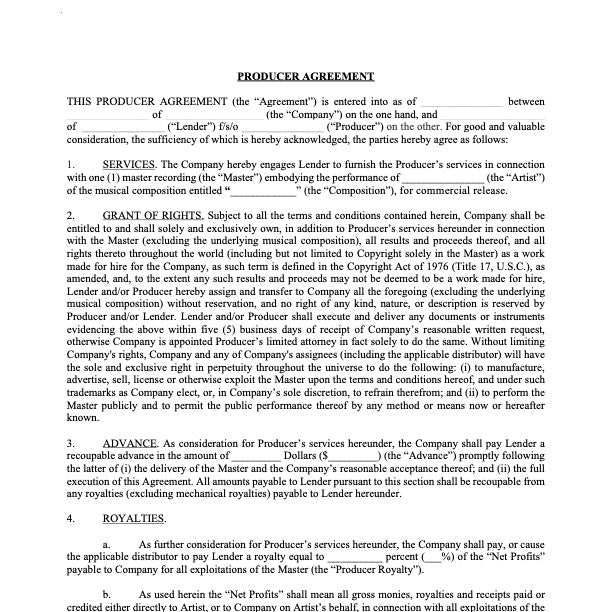
Producer Agreement Template - Furnishing Company (Adv, Royalty & Pub)
Producer Agreement Template - Furnishing Company (Adv, Royalty & Pub)
Couldn't load pickup availability
The producer has a loan-out company, which means you are not contracting with the producer as an individual. You are contracting with their business entity. A producer agreement is the contract between an artist or label and the producer of a recording that sets what the producer is paid, who owns the master, and what share of the composition they keep. This version handles the furnishing arrangement, where the producer's services come through their LLC or corporation rather than from the producer personally.
Written by Adam Freedman, a music attorney with more than 10 years of experience, admitted in New York.
Which producer agreement fits your deal?
The short answer: pick the row that matches how the producer gets paid. This page is the one for when the producer signs through a company rather than personally. The row highlighted below is this page.
| Template | Upfront | What the producer gets on the back end | Use it when |
|---|---|---|---|
|
50/50 Profit Split (No Advance) $20 |
None | 50% of net profits and 50% of publishing | Nobody is paying upfront and you are splitting everything |
|
Advance + Publishing (No Royalty) $25 |
Advance | A publishing share, no master royalty | You want to pay once and keep the master royalty |
|
Advance + Royalty + Publishing $25 |
Recoupable advance | Master royalty and a publishing share | The standard placement deal, all three income streams |
|
Furnishing Company $25 (this page) |
Recoupable advance | The same three streams, paid to the producer's company | The producer signs through an LLC or loan-out |
|
Multi-Track $26 |
Advance, lump sum or per track | Royalty and publishing across every track in the project | One artist, several beats, one agreement instead of five |
|
Producer Agreement Bundle $75 |
Varies | All five structures above | You are not sure which one fits, or you do these deals regularly |
What's included
The furnishing structure
- The signing party: the producer's entity signs, and the individual producer is named as the person whose services it is furnishing.
- Obligation to perform: the company warrants that the named producer will do the work. That warranty is what turns a corporate signature into an enforceable promise about a specific person.
- Inducement provision: the producer personally agrees to be bound if the company fails or disappears. It is built into the document, so you do not need a separate inducement letter.
Services and deliverables
- Scope: what the producer is engaged to produce, whether that is named tracks, an EP, an album, or a set number of masters.
- Recording format: the file type, sample rate, bit depth, stems and session files you expect to receive.
- Delivery deadline: a binding date, with consequences if it slips.
- Revisions: how many rounds sit inside the fee before extra charges start.
Compensation
- Fee and advance: what the company is paid and when, commonly half on signing and half on delivery.
- Royalty rate: the producer's percentage of net master receipts. Independent deals commonly run 3 to 5%.
- Recoupment: whether the advance recoups, and from which income. This is the clause producers lose the most money to, because recoupment that reaches publishing as well as master royalties can delay payment for years.
- Accounting: quarterly or semi-annual statements, with audit rights for the company.
Publishing
- Composition share: if the producer contributed melody, chords or arrangement, their share of the song is defined here and directed to whichever entity they nominate.
- PRO registration: who registers with ASCAP, BMI or SESAC, and who is responsible for the splits being right.
- No publishing transfer: the engaging party acquires no interest in the producer's publishing unless a separate agreement says so.
Master ownership
- Work for hire: the production services and the resulting master are work made for hire rendered by the company, with a copyright assignment as backup.
- Ownership: the artist or label owns the masters. The producer takes royalties, not ownership.
Credits and promotion
- Producer credit: the required wording for streaming metadata, physical releases and promotional material.
- Publicity: the company and producer cannot use the artist's name or the track for their own promotion without written approval.
Standard protections
- Exclusivity: an optional restriction on competing projects during the delivery period.
- Warranties: the services are original, the beat infringes nothing, and no uncleared samples are buried in it.
- Indemnification and governing law: mutual protection, and your choice of state.
Common mistakes this template helps you avoid
Using the direct agreement when the producer has an LLC. Contract with the person when their company holds the rights and you have a document that binds the wrong party. That only surfaces when you need to enforce it.
Skipping the inducement provision. If the company is the only signatory and later dissolves, your counterparty dissolves with it. A newly formed or thinly capitalized LLC offers the artist very little on its own, which is the whole reason this clause exists.
No sample warranty. An uncleared sample in the beat can pull your track from every DSP after release. The warranty does not clear the sample. It gives you a claim against the person who put it there.
Paying the individual instead of the company. The template names the payee, which keeps the accounting and the tax reporting pointed at the same entity.
Who this is for
- Artists and indie labels engaging producers who have formalized their business and require their entity to sign.
- Producers with LLCs or S-Corps who want their company to be the contracting party on every production deal.
- Music managers whose artist is engaging a producer through a furnishing entity.
- Music attorneys and business managers who want a starting point for furnishing company producer deals at the independent level.
Frequently asked questions
How is this different from the standard Advance, Royalty and Publishing version?
The standard Producer Agreement is for a producer signing in their own name. This one adds the inducement provision and specific representations about the entity's authority to bind the producer. Everything else about the economics is the same.
Does the furnishing company own the master or the publishing?
Neither, under the default terms. The engaging party owns the master through the work-for-hire clause. Publishing flows to the producer or their company based on what they contributed to the song. Both are adjustable.
What if the producer's LLC is new or has no assets?
Then the inducement provision is the only part of this document doing real work for you. A thinly capitalized company is a promise from nobody. Get the individual bound.
What if the producer operates as a DBA?
A DBA is a trade name, not a separate legal entity, so there is nothing to sign. Use the direct Producer Agreement Template instead.
What format is the file delivered in?
Microsoft Word (.docx), editable immediately in Word, Google Docs, or Pages.
Not sure which version you need?
The free Producer Agreement Handbook explains every clause.
What happens after purchase
Instant download: Word (.docx) file delivered immediately after checkout.
Fully editable: fill in the company name, producer name, advance, royalty rate, publishing split and delivery terms.
Attorney-drafted: furnishing structure, inducement provision, work for hire, sample warranty and publishing rights all built in.
Reusable: works for every producer deal structured through a business entity.
Also available: the Producer Agreement - Advance, Royalty & Publishing Rights for producers who sign personally. All five producer structures are in the Producer Agreement Bundle.
Want a second set of eyes before you sign? That's what a consult is for.
Need more than one template? The Complete Music Contract Vault bundles 27 music contract templates for $75.
*DISCLAIMER: This template is provided as a starting point and does not constitute legal advice or create an attorney-client relationship. Furnishing company producer agreements involving significant advances, major label distribution, or complex publishing arrangements should be reviewed by a qualified entertainment attorney before signing.
Share