Music Sample Clearance Agreement Template - Master Recording
Music Sample Clearance Agreement Template - Master Recording
Couldn't load pickup availability
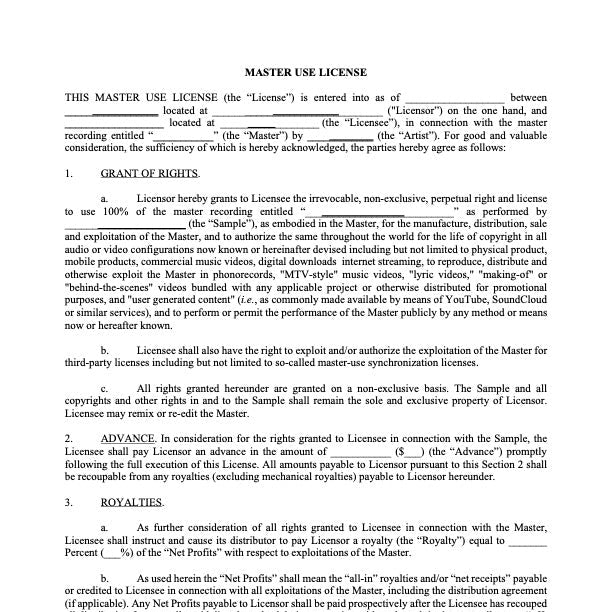
You sampled a specific recording, the actual track, the actual sounds, the actual performance, and clearing that recording is a separate process from clearing the song. A sample clearance agreement is the written license from a copyright owner permitting you to use part of their work in a new recording. This one handles the master side: it licenses the original recording from whoever owns the master, usually the label, producer, or artist, sets the fee or royalty, and documents your authorization to put that recording inside your track.
Written by Adam Freedman, a music attorney with more than 10 years of experience, admitted in New York.
Which sample clearance do you need?
The short answer: every sample has two sides and they are cleared separately, so most released samples need both of these. The row highlighted below is this page.
| Template | What it clears | Who signs it with you | When you need it |
|---|---|---|---|
|
Composition $24 |
The underlying song: melody, lyrics, arrangement | The songwriter or their publisher | Always, including an interpolation you re-recorded yourself |
|
Master Recording $20 (this page) |
The specific recording you lifted | The label, producer or whoever owns the master | Whenever you used the original recording instead of replaying it |
|
Both, inside the Vault $75 |
Both sides, plus 25 other contracts | Both rights holders | Most released samples need both, so this is usually the answer |
What's included
Understanding the master recording side
- Why two clearances: every lifted sample needs two licenses, the composition, handled by the separate Composition Sample Clearance Agreement, and the master recording. This template covers the master only.
- Who owns the master: usually a label, a production company, an independent artist, or a producer. This agreement is executed with whoever controls those rights, which can take some tracing on older records.
License grant
- Description of original recording: identifies the master being licensed, the artist, track title, owner, and the exact portion sampled, for example "bars 1 to 4 of the intro drum loop".
- Description of new work: identifies your track, your artist name, and the intended release format.
- Non-exclusive license: you get a non-exclusive license to use the sampled recording in your master. The owner keeps everything else in the original.
- Territory: worldwide or limited, consistent with your distribution plans.
- Term: perpetual, the standard for cleared samples, or time-limited by negotiation.
Compensation
- Flat buyout fee: a one-time payment, standard for smaller samples from independently owned masters.
- Royalty participation: a percentage of net master receipts from your recording, often structured as a rollover royalty after a sales threshold.
- Co-ownership option: for when the owner wants a percentage of your new master rather than a fee, which is common with a heavily used sample. Covers ownership percentage, royalty splits, and how the co-owner appears in your distribution metadata.
Usage controls
- Permitted uses: streaming, downloads, physical, sync licensing, live performance.
- Approval rights: whether the master owner approves the final version before release.
- Alteration restrictions: limits on filtering, pitching, time-stretching, or otherwise processing the sampled recording.
Credits
- Credit line: the required credit in DSP metadata, liner notes, and streaming profiles, for example "Contains a sample of '[Track Title]' originally performed by [Artist] on [Label]".
- SoundExchange and distribution reporting: how the sample is reflected in master royalty reporting and SoundExchange registration.
Standard legal protections
- Warranties: the licensor confirms they own or control the master and can grant the license.
- Indemnification: mutual protection for third-party claims arising from each side's representations.
- Governing law: your choice of state, enforceable across all U.S. jurisdictions.
Common mistakes this template helps you avoid
Assuming composition clearance is enough: clearing the song does not clear the recording. Use the original master and you need both, and releasing with one side cleared is still infringement, with statutory damages reaching $150,000 per work for willful infringement.
No written license: "they said it was fine" survives exactly as long as the person who said it stays in the job. Catalogs get sold, and the new owner inherits every claim, including the one against you.
Undefined scope: without naming the exact portion licensed, the licensor can later argue the license never covered what you actually used.
Ignoring sync: if the track later gets placed in a show, a film, or an ad, the sample has to be cleared for sync specifically. The permitted uses section covers it upfront, which is much cheaper than covering it under a deadline.
Who this is for
- Producers and beatmakers who flipped a recognizable record and need documented master clearance before distribution.
- Independent artists who sampled an original recording and need both sides licensed before the release date.
- Indie labels needing clean chain of title for their distribution agreement.
- Music supervisors who need complete clearance documentation, both sides, before a track can be licensed.
Frequently asked questions
How is this different from the Composition clearance?
The Composition template clears the underlying song, owned by the songwriter and publisher. This clears the specific recorded version you sampled, owned by the label or master owner. Most sampled tracks need both. If you re-recorded the part yourself, an interpolation, you need only the composition side. If you are still working out what your track needs, your sampling questions, answered walks through the common situations.
How do I find out who owns the master?
For major label recordings, the label's licensing department. For independent recordings, the artist, producer, or manager. For older or out-of-print records, Discogs and AllMusic help identify the original label, and ownership may have moved since.
What if the owner wants co-ownership instead of a fee?
Increasingly common with a recognizable break or hook. The template includes the co-ownership option covering percentage, royalty participation, and metadata. That structure has long tails, so it is worth a conversation before you agree to it.
Do I need clearance if I am only releasing on SoundCloud?
Legally, yes. Copyright does not turn on the platform, and labels monitor everywhere. Practically, anything heading to commercial DSPs needs clearance before it goes up.
Is a very short sample safe?
Length is not a safe harbor. There is no dependable rule that a certain number of seconds or notes is free, and courts have gone different ways on short samples. If it is recognizable, treat it as needing clearance.
What format is the file delivered in?
Microsoft Word (.docx), editable immediately in Word, Google Docs, or Pages.
What happens after purchase
Instant download: Word (.docx) file delivered immediately after checkout.
Fully editable: fill in the recording details, license fee, permitted uses, and credit requirements.
Attorney-drafted: covers flat fee, royalty, and co-ownership structures, with the credit language master owners usually require.
Reusable: use it for every master clearance you execute.
Also available: the Music Sample Clearance Agreement - Composition to clear the publishing side of your sample.
Have a deal in front of you right now? Bring it to a consult.
Need more than one template? The Complete Music Contract Vault bundles 27 music contract templates for $75.
*DISCLAIMER: This template is provided as a starting point and does not constitute legal advice or create an attorney-client relationship. Sample clearance involves complex copyright questions and significant financial exposure. For high-profile samples or tracks intended for major commercial release, consult a qualified entertainment attorney before proceeding.
Share