Sync Licensing Agreement Template - Music Sync Placement
Sync Licensing Agreement Template - Music Sync Placement
Couldn't load pickup availability
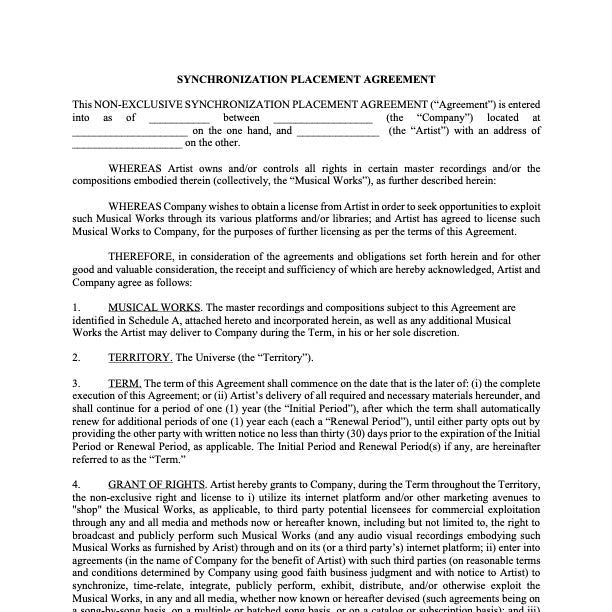
A sync agent wants to pitch your music for TV, film, and advertising, and you need a written agreement before your catalog goes anywhere near a music supervisor. A sync licensing agreement of this kind is the contract between an artist or label and a sync agency: the agency gets the right to pitch and license your music for placements, you keep ownership of everything, and the territory, term, fee split, and approval rights are settled before anyone pitches a note. This template is the non-exclusive version, so you can work with more than one agency at a time.
Written by Adam Freedman, a music attorney with more than 10 years of experience, admitted in New York.
Which licensing document do you need?
The short answer: this one when someone is licensing your music out. The clearance templates are for the reverse, when you want to use somebody else's work. The row highlighted below is this page.
| Document | Direction | Use it when |
|---|---|---|
|
Sync Licensing Agreement $25 (this page) |
Your music going out | A sync agency will pitch and license your catalog for placements |
|
Sample Clearance, Master Recording $20 |
Someone else's recording coming in | You sampled an actual recording and need the owner's permission |
|
Sample Clearance, Composition $24 |
Someone else's song coming in | You used the melody or lyrics and need the publisher's permission |
|
Appearance Release $5 |
Someone's likeness coming in | A person appears on camera in your video |
|
Complete Music Contract Vault $75 |
Both directions | You would rather have all of them on hand |
What's included
Grant of rights
- Non-exclusive license: the agency gets a non-exclusive right to pitch and license. You keep the right to work with other agents, license directly, or sign with a publisher at the same time.
- Sync rights defined: the agency's right to license your masters and compositions for synchronization with TV, film, advertising, video games, YouTube, branded content, and other audiovisual formats.
- Territory: worldwide or specific territories, defined rather than assumed.
- Term: the initial period, renewal terms, and how either side gets out.
Music catalog
- Catalog definition: which tracks are in the pitch catalog: everything, a curated set, or tracks delivered on a rolling basis.
- Delivery specs: file format, stems, ISRC codes, and PRO registration information the agency needs to place a track.
- New tracks: whether new material joins the catalog automatically or by separate submission.
- Exclusion rights: your right to pull specific tracks, or to block whole categories of client.
Licensing fees & revenue split
- Sync fee structure: whether the agency can quote and accept fees on your behalf up to a threshold, or whether every fee needs your sign-off.
- Revenue split: your percentage against the agency's commission, editable to whatever you negotiated.
- Master vs. publishing split: whether the agency is licensing both sides and how each is tracked and paid.
- Payment schedule: when your share is remitted: monthly, quarterly, or on receipt.
Approval rights
- Placement approval: whether you approve each placement or the agency has authority up to a dollar amount.
- Brand exclusions: your right to rule out categories, political content, alcohol, tobacco, and anything else, without justifying each call.
- Turnaround requirements: the response window, so the agency can still meet a supervisor's deadline.
Reporting, ownership & termination
- Placement reports and accounting: periodic reports of placements, fees quoted, licenses granted, and revenue collected, plus statements with your share broken out.
- Audit rights: your right to check the agency's records, subject to notice.
- No transfer of ownership: the agency gets a license to pitch and place, never ownership. You keep 100% of your masters and compositions.
- Termination and post-term tail: notice periods, whether the agency commissions deals negotiated before termination but signed after, and what happens to your files and metadata.
Common mistakes this template helps you avoid
No approval rights: without them an agency can place your music against a political campaign, a brand you would never endorse, or content that undoes years of positioning, and you find out when it airs.
Exclusivity buried in the language: some agency agreements are exclusive in practice without saying so. This one is explicitly non-exclusive.
No reporting requirement: an agency that does not report leaves you unable to check what was licensed, whether you were paid correctly, or whether the PRO registrations are right.
No tail provision: deals in negotiation when you terminate are exactly where the argument happens. Write down who gets paid on those.
Who this is for
- Independent artists and producers signing with a sync agency and wanting written terms before any pitching starts.
- Music supervisors and sync agents formalizing representation with clear authority, commission, and reporting obligations.
- Production music composers licensing catalogs to multiple agencies at once.
- Indie labels engaging an agency to pitch a label catalog while keeping ownership and approval rights intact.
Frequently asked questions
Does a sync placement need both the master and the composition cleared?
Yes. A sync license requires clearance from whoever owns the recording and whoever owns the song, which are frequently different people. This template covers the agency's authority on both sides and how the fees from each are split. The same two-sided structure is why a sample needs both a master license and a composition license.
What is a typical sync agency commission?
Non-exclusive arrangements commonly land in the 40 to 50% range of the sync fee, with exclusive deals at the higher end. The percentage in the template is a placeholder for what you actually agreed.
Can I still pitch my own music directly?
Under this non-exclusive agreement, yes. If a supervisor you approached directly licenses the track, the agency typically earns nothing on it, and the template says so rather than leaving it to interpretation.
What happens to placements if I terminate?
Licenses already granted survive, so placed music stays placed. The tail provision governs deals still in negotiation at termination.
Am I being offered a fair deal?
That depends on the split, the term, the approval rights, and the tail together rather than any one of them. Here is how a music attorney reads an offer like that.
What format is the file delivered in?
Microsoft Word (.docx), editable immediately in Word, Google Docs, or Pages.
What happens after purchase
Instant download: Word (.docx) file delivered immediately after checkout.
Fully editable: fill in the agency name, catalog scope, commission split, territory, term, and approval rights.
Attorney-drafted: non-exclusive structure, approval rights, reporting requirements, and post-term tail all built in.
Reusable: use it for every sync agency relationship you enter.
Received an agreement you'd like to discuss? Send it over and we can go through it together.
Need more than one template? The Complete Music Contract Vault bundles 27 music contract templates for $75.
*DISCLAIMER: This template is provided as a starting point and does not constitute legal advice or create an attorney-client relationship. Sync licensing agreements involving major catalog representation, exclusive arrangements, or significant upfront advances should be reviewed by a qualified entertainment attorney before signing.
Share