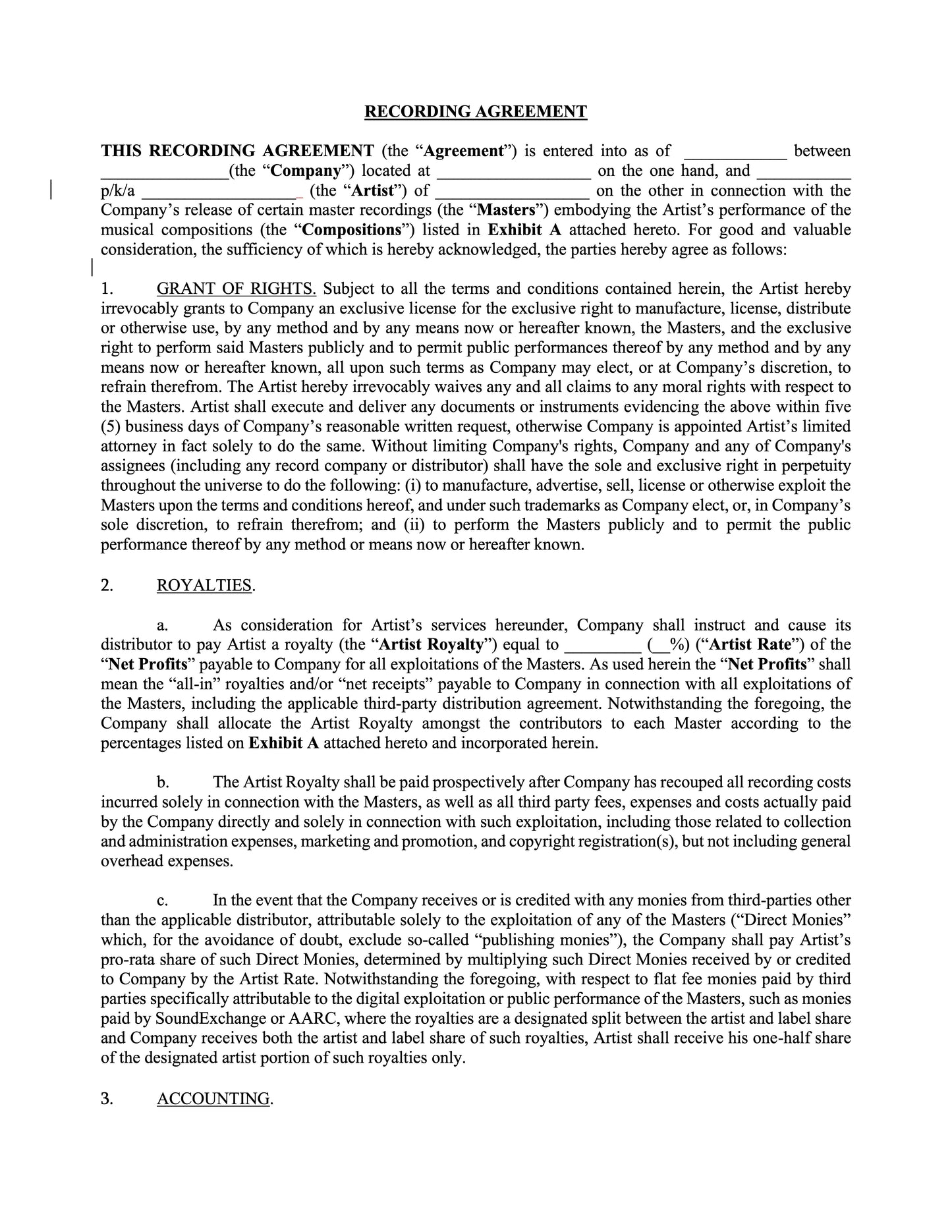
Record Label Contract Template - Artist Recording Agreement
Record Label Contract Template - Artist Recording Agreement
Couldn't load pickup availability
Signing artists without a proper recording agreement is how you end up in a dispute over who owns what, who gets paid, and who controls the music. A record label contract, or artist recording agreement, is the contract between a label and an artist that sets the term, how many recordings the artist owes, what the label pays, who owns the masters, and what the artist earns from them. This template is built for independent labels releasing multi-track projects: EPs, albums, and compilations.
Written by Adam Freedman, a music attorney with more than 10 years of experience, admitted in New York.
Which label document do you need?
The short answer: this one if you are signing an artist to your label. The others cover managing an artist, launching the label, or splitting a project between equals. The row highlighted below is this page.
| Document | The relationship | Use it when |
|---|---|---|
|
Artist Recording Agreement $35 (this page) |
Label signs artist, label owns the masters | You are putting an artist under an exclusive recording term |
|
Artist Management Contract $49 |
Manager represents artist for a commission | You are managing the career, not owning the recordings |
|
Music Collaboration Agreement $20 |
Two creators, equal partners, no label | You are splitting a project down the middle with someone |
|
Indie Record Label Starter Kit $65 |
This agreement plus producer, featured artist, and NDA | You are launching the label and need the whole first set |
|
Complete Music Contract Vault $75 |
Everything above, plus sample clearance, sync, and crew | You would rather never buy a template again |
What's included
Grant of rights
- Exclusive recording services: artist grants the label the exclusive right to record, release, and exploit their recording services during the contract term.
- Territory: worldwide or a defined territory; you specify the scope of your distribution and exploitation rights.
- Field of use: all configurations: streaming, downloads, physical, sync licensing, and any new formats developed during the term.
- Master ownership: label owns the master recordings created under the agreement, with the artist receiving royalty participation rather than ownership.
Contract term & album commitment
- Initial period: clearly defined first contract period (one album, or a specific number of masters), with optional label renewal periods.
- Option periods: label options to extend for additional album cycles, with artist consent rights addressed.
- Recording commitment: the number of sides or full albums the artist must deliver during each period.
- Delivery conditions: the technical and artistic standard for an acceptable delivery, including release format and timeline.
Advances & recording costs
- Recording fund or advance: any advance paid to the artist or fund allocated to studio costs, with recoupment provisions.
- Recoupment: which expenses are recoupable from artist royalties (recording costs, advances, video production) and which are not.
- Cross-collateralization: whether albums under the agreement are cross-collateralized for recoupment.
Royalties
- Master royalty rate: the artist's percentage of net receipts from exploitation of the masters.
- Royalty base: the defined base, accounting for distribution fees and applicable deductions.
- Accounting periods: semi-annual or quarterly accounting, with statement deadlines and payment timelines.
- Audit rights: the artist's right to audit once per accounting period, subject to notice and procedure.
Creative controls
- Approval rights: who approves track selection, artwork, videos, and marketing materials.
- Producer selection: who picks producers, and how the producer agreements underneath this deal are handled.
- Release commitment: optional label obligation to release within a defined period or revert rights.
Controlled composition & publishing
- Controlled composition clause: the mechanical royalty rate payable on songs written or co-written by the artist.
- Publishing ownership: confirms the label acquires no publishing; the artist keeps it unless a separate publishing agreement is signed.
Standard legal protections
- Suspension and termination: what happens if the artist fails to record or deliver, or if either party breaches.
- Reversion of rights: when rights revert if the label fails to release or pay.
- Warranties and representations: the artist confirms no conflicting agreements and original contributions.
- Indemnification and governing law: mutual protection, and your choice of state.
Common mistakes this template helps you avoid
No defined term or album commitment: an open-ended exclusive deal with no defined scope invites a dispute about how long the relationship lasts, and in some states raises enforceability problems.
Recoupment left undefined: if advances and recording costs are not stated as recoupable, and from which stream, an artist can argue they never agreed to recoupment at all.
No reversion clause: without one you could sign an artist, pay an advance, never release the music, and hold the masters forever. Artists need the protection, and labels that offer it read as credible partners.
No controlled composition clause: without it you may owe full statutory mechanical rates on every controlled composition, which indie label economics generally do not support.
Who this is for
- Independent record labels signing artists for EP or album projects and needing a real recording agreement.
- Artist-owned labels signing other artists, or signing themselves through their own entity.
- Music producers who have started an imprint and are formalizing artist relationships beyond a handshake.
- Emerging artists who have been offered an indie deal and want to see what a normal one looks like before paying for a review.
Frequently asked questions
Is this a 360 deal?
No. This is recording only, so the label's rights stop at the masters. Nothing here captures touring income, merchandise, endorsements, or publishing. A 360 structure is custom drafting.
Does it work for a single or an EP?
Yes. The commitment provisions are bracketed, so you can structure around a single, an EP, or a full album.
Should I be doing a record deal or a distribution deal?
Different economics and very different control. A distribution deal leaves the artist owning the masters and paying a fee; a recording agreement moves ownership to the label in exchange for investment. This breakdown of record deal versus distribution deal walks through which one fits a given roster.
Who owns the artist's publishing?
The artist does, by default. The controlled composition clause sets the mechanical rate the label pays on the artist's own songs, but the label acquires no interest in the compositions.
Can the artist record for other labels during the term?
The exclusivity provision restricts it. Featured appearances and other carve-outs are addressed in the template and are usually where the negotiation lands.
What if the label never releases the album?
The reversion clause covers it. Miss the release window and rights go back to the artist.
What format is the file delivered in?
Microsoft Word (.docx), editable immediately in Word, Google Docs, or Pages.
What happens after purchase
Instant download: Word (.docx) file delivered immediately after checkout.
Fully editable: fill in the label and artist names, term, advance, royalty rate, and recording commitment.
Attorney-drafted: built for independent label deals rather than retrofitted from major label boilerplate.
Reusable: use the same template for every artist you sign.
Running a label? Also consider the Producer Agreement Bundle for your production relationships, and the Indie Record Label Starter Kit, which pairs this agreement with the producer, featured artist, and NDA paperwork.
Received an agreement you'd like to discuss? Send it over and we can go through it together.
Need more than one template? The Complete Music Contract Vault bundles 27 music contract templates for $75.
*DISCLAIMER: This template is provided as a starting point and does not constitute legal advice or create an attorney-client relationship. Recording agreements are significant legal commitments. Before signing any multi-album or long-term exclusive deal, both parties should consult qualified entertainment attorneys.
Share